We are always looking for a good challenge, preferably one that takes us offshore. If you look at the Belgian part of the North Sea, there are no islands that you can paddle to (with the exception of the North Sea crossing to the UK). We have to do it with our buoys, navigation marks and towers. Yes, there are towers located in the Southern part of the North Sea. Two of them are drawing our attention. The first, and closest one, is the Oostdyck radar tower. When visibility is extremely well, it can be seen from the beach without binoculars. The radar sends all shipping movements to the Traffic Centre for monitoring. This tower is located some 21 kilometres offshore. What cannot be seen from ashore is the second tower located at the Westhinder sandbank. This one lies just behind the international shipping lane, one of the busiest in the world. The Westhinder beacon warns ships for the danger of the sandbank beneath. It also monitors the force of the wind and direction, which is important for the weather forecasts for this area. This tower is located some 32 kilometres offshore.
To take on this challenge you’re not only need a good physical condition and stamina, you also have to know more than basic navigation. There is always a strong tidal stream that pushes you constantly off track, the stream is never in you favour. Taking a break, even a short one, relentlessly pushes you off track. Also the strength of the tidal stream changes every hour, so you have to keep a good eye to your bearings. During the most of the challenge, you will not have any reference to paddle to. When you reach the first tower, you still have to cross the international shipping lane, which is one of the busiest in the world. Keep in mind that those very large ocean ships probably want see you, or change their course or speed for a sea kayaker. When you crossed the shipping lane and finally reach the Westhinder beacon, then you just completed the first half of the challenge. The second half, and the most important one, is to get yourself and your team back to shore safely. If you’re tired, you can’t just quit. There is no support boat to help you. There is only you and your team.
I’m proud to say that were able to put together a small international team to take on this challenge. Two very experienced and well trained Spanish sea kayakers were eager to take on this challenge. They travelled all from Spain to Belgium, we spend some days paddling together, before heading out. On Saturday 7 July 2017 we started from the Oostduinkerke beach, at 07:40 am (local time). As an extra difficulty we chose to navigate on compass, with a sea chart. We carried also a GPS, just for registration and safety precautions, not for navigation. We stated our intentions to the Coast Guard by radio before the start. We paddled at a high pace, in order to compensate a bit lesser for the sideways tidal stream. In the video you can see the buoys that we have passed, the way we have taken on this challenge. It took us seven hours to reach the Westhinder beacon. When we got there we established radio contact with the Coast Guard again, to tell them our position and that we were still in good shape to commence the way back to shore. It was 14:30 pm (local time) and we were at the farthest offshore point, being 32 kilometres. When arriving there, perhaps euphoric, we just did half the challenge. The second part, also the hardest, was to get back with the team. It’s also a psychological battle because you have absolutely nothing to look to, there are no references, and you cannot see the land for hours. The visibility was limited to ten kilometres, which is normal for us. You have to trust your navigation skills, simple as that. Even when tired, we still kept the same high pace to counter the current. We arrived back at Oostduinkerke beach at 20:55 pm (local time).
In the video you can see our GPS track log. The GPS was not turned off during our short breaks. It registered all of our movements during the challenge.
To all other sea kayakers out there who are looking for a tough challenge, this could be what you are looking for. Be well prepared for this one, both physically, mentally and be sure of you navigation skills.
I got extremely lucky to do this one with such experienced sea kayakers! Big thanks to Carlos GARCIA and Santi DOMINGUEZ for joining! It was an honour to be part of this team, and to beat this challenge together! Check out this unique record on the Performance Sea Kayak website; http://www.performanceseakayak.co.uk/Pages/Records/Uniques/recordsUniques.php
When we got a first email from Will and Beverly, from the North Skye Kayak Club in Scotland, we never imagined that we would have that much in common. They asked if they could join us on our training sessions along the Belgian coast to see how we are doing things, and also to meet the NORTHSEAKAYAK-team. We think that Scotland has sent out their most friendliest inhabitants, there was immediately a good connection between us! Upon their arrival in Belgium we chose to do a variety of training sessions in the four days of their stay. On the first day, we did an offshore trip to the marine farm in front of Nieuwpoort. We combined that with some rescue exercises along the way. The second and third day we did a typical “harbour-training” in Nieuwpoort. It’s a perfect venue to teach/learn a variety of skills. We did balance exercises, trained on self-rescue and assisted rescue techniques. With all the palisades, docks, mooring stations and boats it also makes a good spot to train on boat-control . We use them to paddle around in order to train the different steering strokes while being in a safe environment. We saved the best for last, the fourth and last day we had perfect surfing conditions. The swell was good, and the waves steep but not too high. We gave an explanation on the behaviour of the waves, the wave sets and how to paddle trough the surf and back. Being on a wave, gaining speed and rushing back to the beach is one of the most exciting things you can do with a sea kayak. We think that those smiles we got during the visit of our Scottish friends will stay on for a longer period of time. We hope to visit them in the future, on the beautiful Isle of Skye!!

On Sunday 27 August P&H dealer Manu Redureau, of Bekayak, Brest, France, joined me for a blast around the Stacks. This trip also gave Manu the opportunity to try out the Delphin MKII Corelite X in rough water conditions.
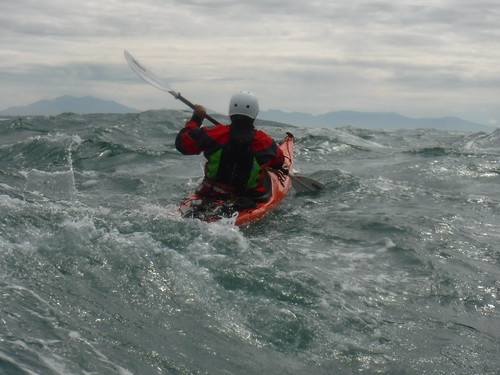
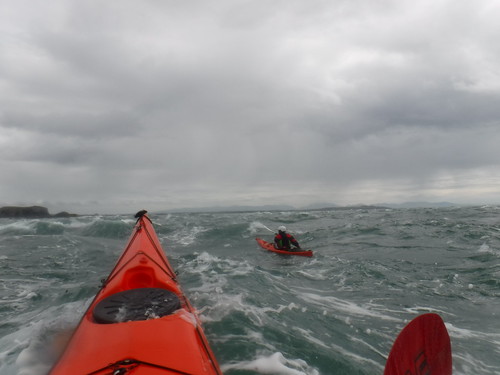
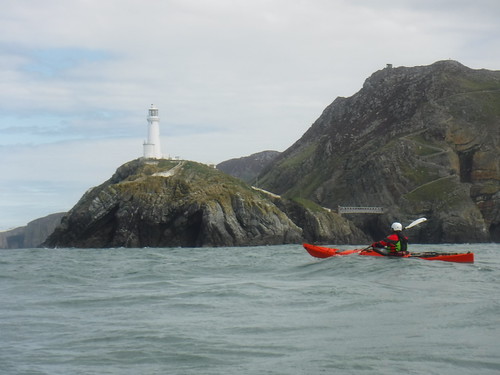
Our journey took us from Porth Dafarch to North Stack and back – similar to the route shown below from the ‘Welsh Sea Kayaking: Fifty Great Sea Kayak Voyages’ book. We enjoyed surf and rough water at Penrhyn Mawr, followed by some small surf at South Stack before lunch on the rocks in Gogarth Bay – the seal pupping season from August to November precluded us from using the beaches. After lunch we returned to Porth Dafarch by closely following the coastline and exploring lots of channels, arches, caves and rock gardens. The journey was both fun and a great work out. Thanks for a great day out Manu!
Geth Roberts, www.seakayakingwales.com

Penrhyn Mawr


South Stack

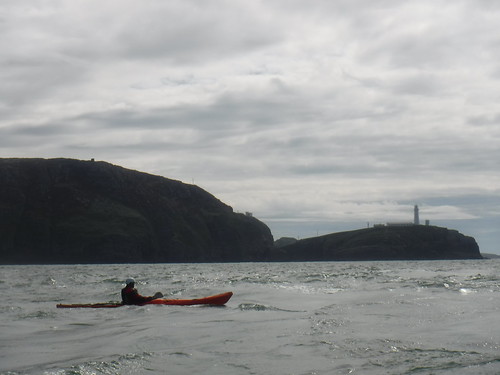
Wen Zawn and Cathedral Arch
A smaller Gogarth Bay arch
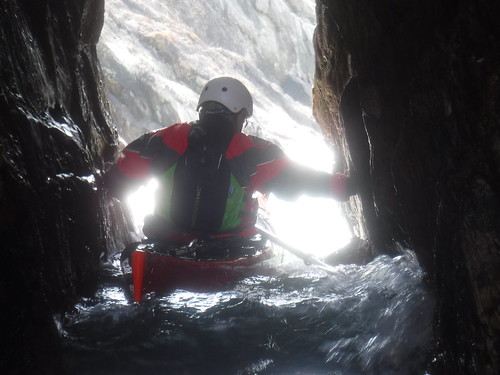
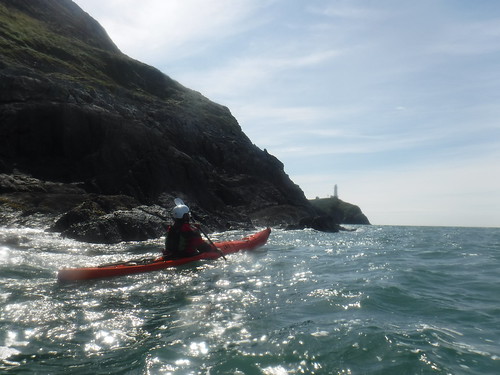
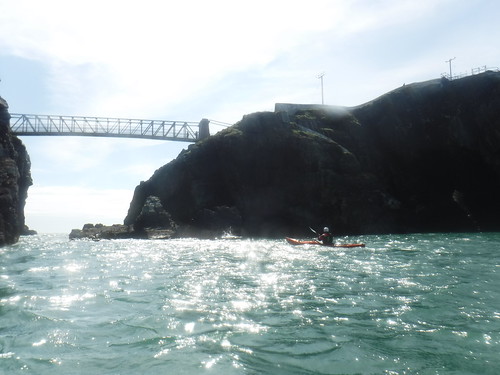
Below Elen’s Castle


Abraham’s Bosom

Our Training Day has been a success. It is the third edition so far, with the same ingredients as before. The goal is to get sea kayakers, whatever their skills, level, age or gender, together for safety training. Again, we’ve seen both experienced paddlers train with the less experienced and this works very well. For the newcomers it’s ideal because they can learn things the right way from the start. For the more experienced paddlers among us it’s also a good way to correct the little mistakes, or refine their skills. We chose the canal at the Westhoek Marina because it allows us to train a larger group, while everybody stays in the immediate vicinity. Perfect to keep an eye out for everyone, give feed-back or for the participants to ask questions. In the morning we highlighted the theoretical side, we explained some important safety rules, talked about equipment and the good use of it. We explained, with the help of some videos, how people can rescue themselves after a capsize, how they can rescue another paddler after a capsize. During the afternoon we’ve convert all those things into practice. We’ve got the permission to launch some distress flares and pyrotechnics. Lessons are learned, never trust on one or two flares if your life depends on it. Better to have some more on board. Many thanks to the Waterway Police for their presence during the demo. Thanks to the people of the Westhoek Marina for the venue! This day would not have been possible without the help of those working behind the scenes, so a big thanks to those! Again, it was a true pleasure working with such motivated and responsive people.
For the third and probably the last time I was asked by the Cervo Go photographers team to join in on a so called light painting session. We made arrangements with instructor Fanny, for a meeting with her team at Nieuwpoort harbour. Light painting is photographing a moving light with a longer shutter time; the effect is a long, bright line in one picture. The camera has to be positioned on a tripod because it may not move, not even a bit. This year the challenge was to get the kayaker also in the picture, the use of the camera flash makes this possible. Several try outs were made just before dark, just to get thing perfectly right. Trajectory, distance and communication were key to allow the photographers to make their perfect photo. There was a light strip attached to the paddle, which makes those graceful and colourful lines in the photos. The video shows the setup and how it is done, at the end there are a few pictures included, just to show the result of the hard work. Again, it was a true pleasure to work with passionate people. It is really great to see the result of the cooperation between photographer and sea kayaker.
One of the worst things that can happen to a sea kayaker is the loss of his of her kayak at open sea. Mostly we paddle as a group, if paddling alone some of us are tethered to their kayak. But you never know, if that moment comes when due to circumstances you lose your craft. In our team we always carry a good quality PFD, good clothing (dry suit or wetsuit) and a means to call for help. I have always been a big fan of good quality VHF radios combined with the knowledge to make use of it in a good, responsible way. It has the benefit of two way communication, you can reach a large number of receivers, and if your message is received you get direct response. You know if and when help is coming. Make sure to load the batteries every single time you go out on a trip.
You should carry a minimum of items on your person. A VHF radio or a cell phone at least. A flare, maybe two if you got the place, the mandatory whistle, a knife, a PLB, a water reserve (camel back type). The more you carry, the more options you got when the need arises. Today we got lucky, we were able to train with the crew of the R6 ORKA lifeboat. Conditions were great, no wind, no waves, sunny but a water temperature around 11°C. Even in these conditions it was difficult to spot a single person in such a big body of water. Therefor it’s always better if you can stay near your kayak…. But in this case, the kayak was gone! A good VHF should float and should be waterproof by itself (not by carrying it in a waterproof bag). Most rescue services make use of a so called homing device, they can reach your location faster that way if you broadcast that is. If you got the chance to train together with rescue services, grab that chance with both hands! It’s always a good to learn and share experience. I want to thank the R6 ORKA Lifeboat crew for their contribution to this exercise!
One of our own team mates capsized, lost his kayak and got unconscious three kilometres offshore during our last trip. It’s probably one of the worst nightmares that can happen to us. Luckily it’s just a training scenario, the “worst case scenario” in fact! In our group we train these things on a regular base. Not only because we paddle safer, but also to build up trust in each other, to learn from mistakes and to get better in what we do. It’s also team building and thus great fun! The week before we did practically the same scenario but in rougher conditions, it works also. It’s important to state that this is in no way a training video, we just want to show what is possible and how we respond to such an incident as a team. There is certainly no “one solution for every problem”, but this is a possible way to counter these events. Always make sure to take care of the (unconscious) paddler first. Retrieving his kayak comes later. If the paddler is conscious and you’re sure that he is OK, you can go after the drifting kayak and bring it back to him. Most important is to communicate with each other in a loud and clear way. Work always as a team not as an individual, get everyone involved. Make sure to take First Aid classes every now and then, make sure to know how to use your equipment (radio, cell phone, Personal Locater Beacon,….) and dress for immersion. Always wear your PFD, no exceptions!
I have a question. Why do you go paddling? I asked myself that very same question years ago. Years ago my answer was because of the sports, the adventure, the close contact with nature… Now my answer has slightly changed. I kept telling myself that I’m addicted to sea kayaking, that I needed the workout and the companionship of my teammates. That is maybe not the whole truth. Those reasons are merely a cover up for what is maybe the real reason. I’m addicted to the sea… Do you think that a fisherman sails the seas his whole life just to catch fish…? It’s that attraction I think…. That counts for us also. We are sea wanderers! We love to be in the salt water, for so called rescue drills! Yeah right! While sea kayaking we spend perhaps more time in the water than in our craft. And the smiles, that’s an extra!
As a sea kayaker I’m often confronted with pollution. On my many trips I encounter a variety of marine litter. The things I recover the most are balloons, Styrofoam, fishing nets, toys (especially during the summer months), plastic bags, tin cans and bigger things. I’m hoping to convince others to take the initiative of collecting garbage, and to put it where it belongs; in the bin! I know I’m not alone, I’m certainly not the only one doing this on a regular base, but there’s much work to be done. We also have to change our mind set and way of life. We have to stop using that amount of plastic in our daily lives. I made this video with the footage of years filming and photographing, in order to shove it under the noses of those who are thinking that there is nothing wrong! We have to take care of our playground, it’s full of life and beauty. The only thing that is missing sometimes is the will to act! So don’t think, but DO!
We are in the first place real sea admirers, and in the second place sea kayakers. This is the last video of the year 2016. It contains footage of the last sessions we did with the team. After ten years of wandering our piece of the North Sea, we are more enthusiast than ever! We wanted to start the video with a fitting poem, as a tribute to this wonderful water mass that provides us with intriguing, challenging and beautiful conditions to paddle in. We want to thank all our team members for their friendship, our sympathizers for their support and al others who made our team grow during those last years. Come with us on our last journey of 2016, we’ll see each other next year on the water!