Sea Kayaking Articles from P&H Staff, Team Paddlers, and Friends

Tag: Sea Kayaking in Scotland

Playing the Long Game: A Journey to Muckle Flugga

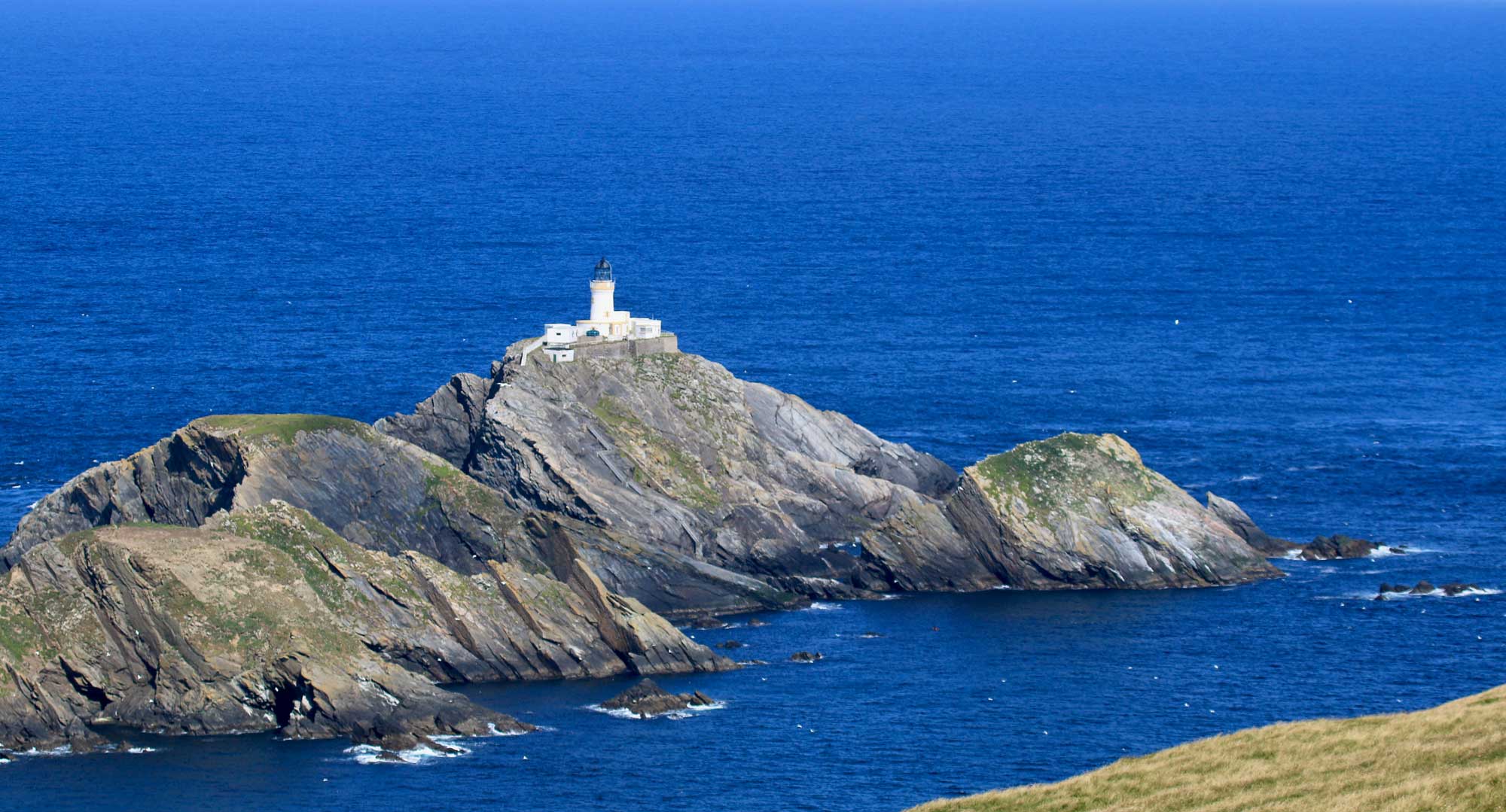
Muckle Flugga

The Shetland Islands lie around 160km north of mainland Britain, surrounded by the Atlantic Ocean and the North Sea, and exposed to every swell and weather system they can throw at them. They’re not for the faint-hearted, yet for generations of paddlers they’ve become a sea kayaker’s mecca. That’s thanks to an extraordinary coastline of towering cliffs, immense sea stacks, cathedral-sized caves and countless arches, together with an archipelago of islands waiting to be explored. Yet it isn’t just the scenery that draws people back. It’s the wildlife—from thousands of nesting seabirds to seals, otters and killer whales—and the warm welcome from the people who call these remote islands home.
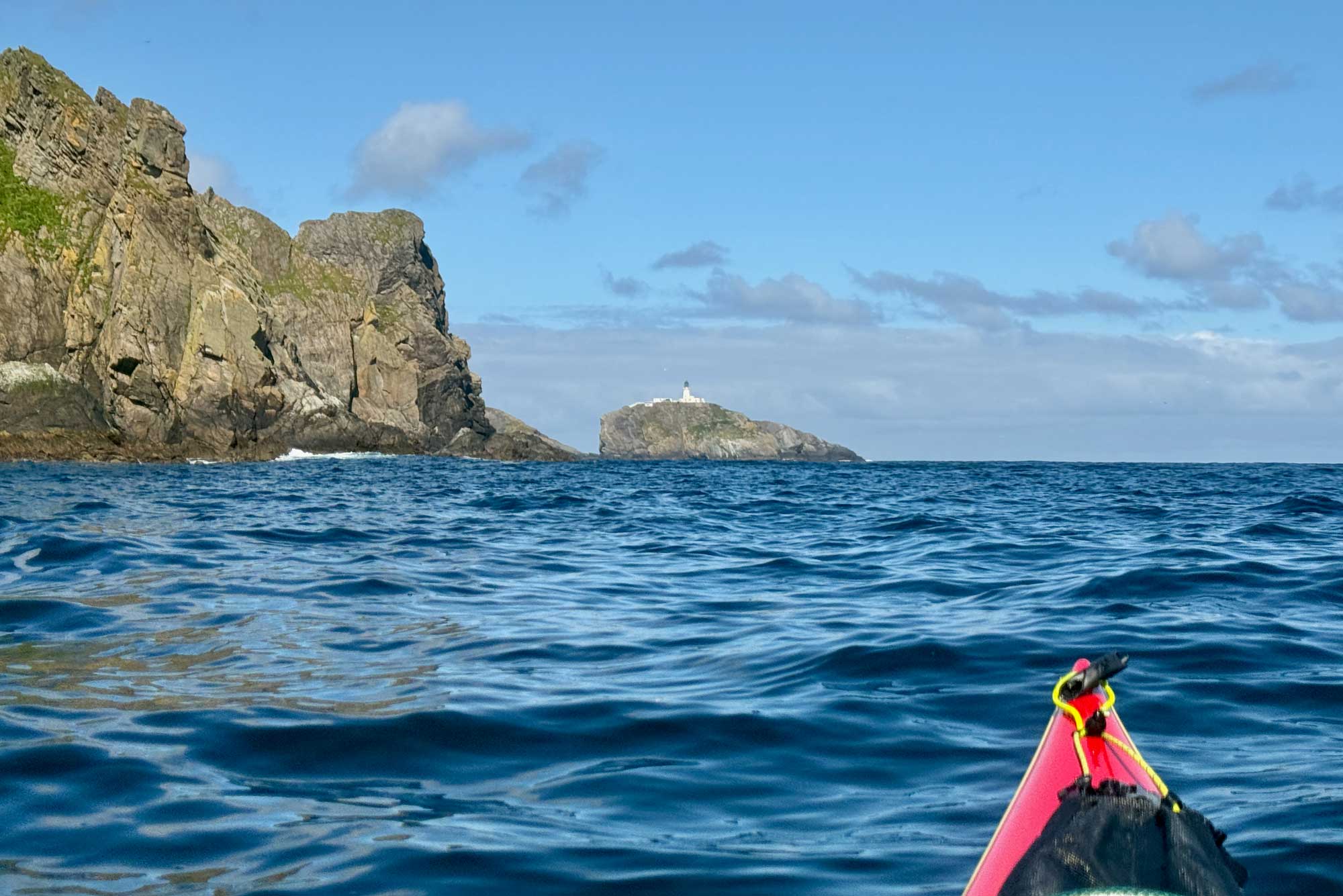
First sight of Muckle Flugga

It is for these reasons that I, like so many other sea kayakers, have fallen in love with these remote islands and always look forward to returning. This year was no different. I was invited north to coach with the local kayak club during the biannual Shetland Sea Kayak Symposium, organised entirely by dedicated volunteers. The welcome, as always, was warmer than the weather. Despite the wind, grey skies and rain, more than 100 paddlers took to the water each day to enjoy the symposium and the unique Shetland experience. The paddling was, of course, fantastic, but it was probably the cakes, conversations, new friendships and the ceilidh that created the strongest memories.
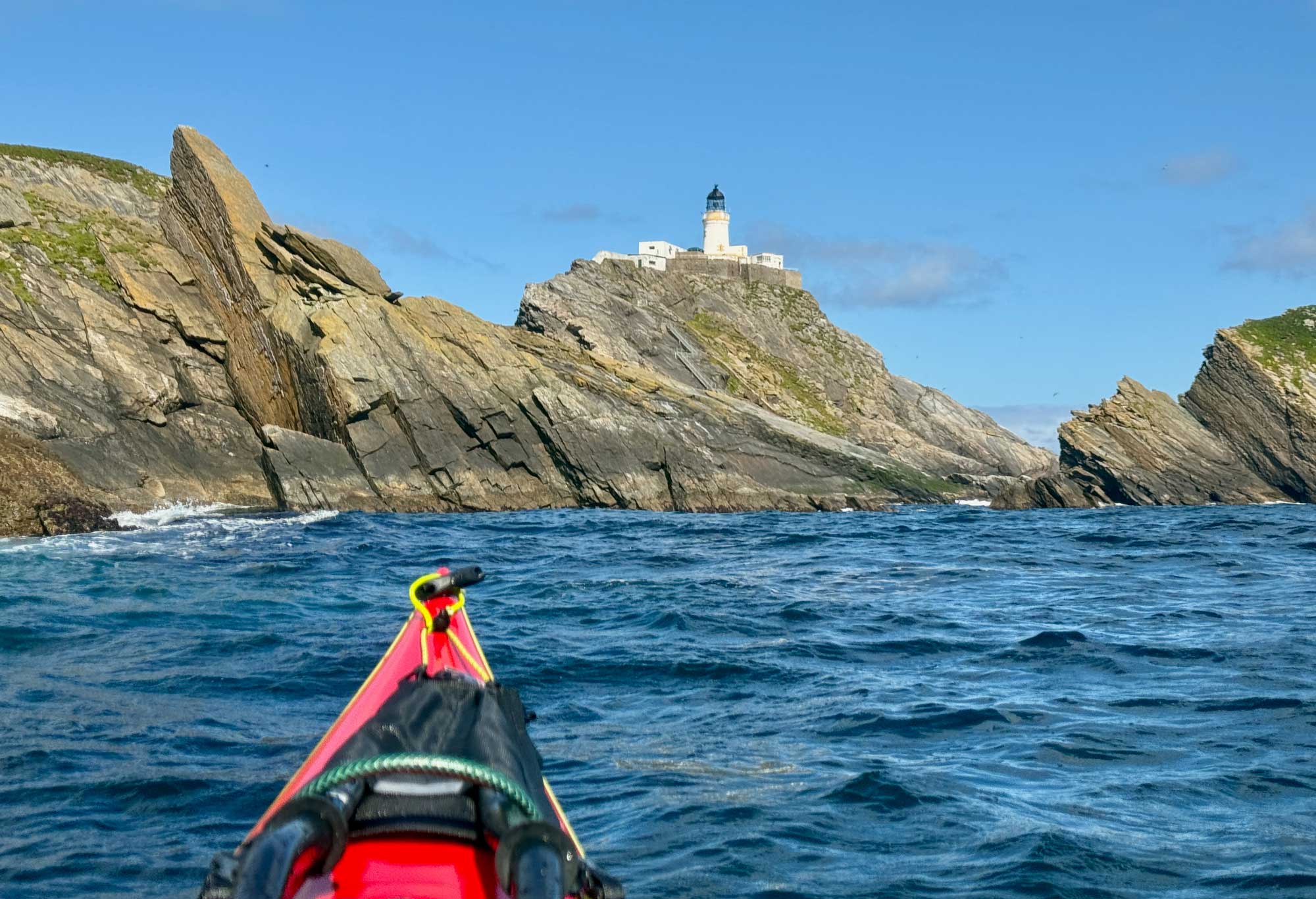
Approaching Muckle Flugga, the landing steps up to the lighthouse are visible.

Over the years I’ve learnt that sea kayaking in Shetland is all about playing the long game. The weather decides what you paddle, not your ambitions. With near-constant winds and swell for much of the time, opportunities to paddle some of the more spectacular exposed sections of coastline are few and far between. With this in mind, there has been one particular trip I’ve waited years to make. If Shetland is the icing on Scotland’s sea kayaking cake, then Muckle Flugga is the cherry on top. Home to Britain’s northernmost lighthouse, it stands at the very edge of our world and can only be reached when weather, wind and tide finally align.
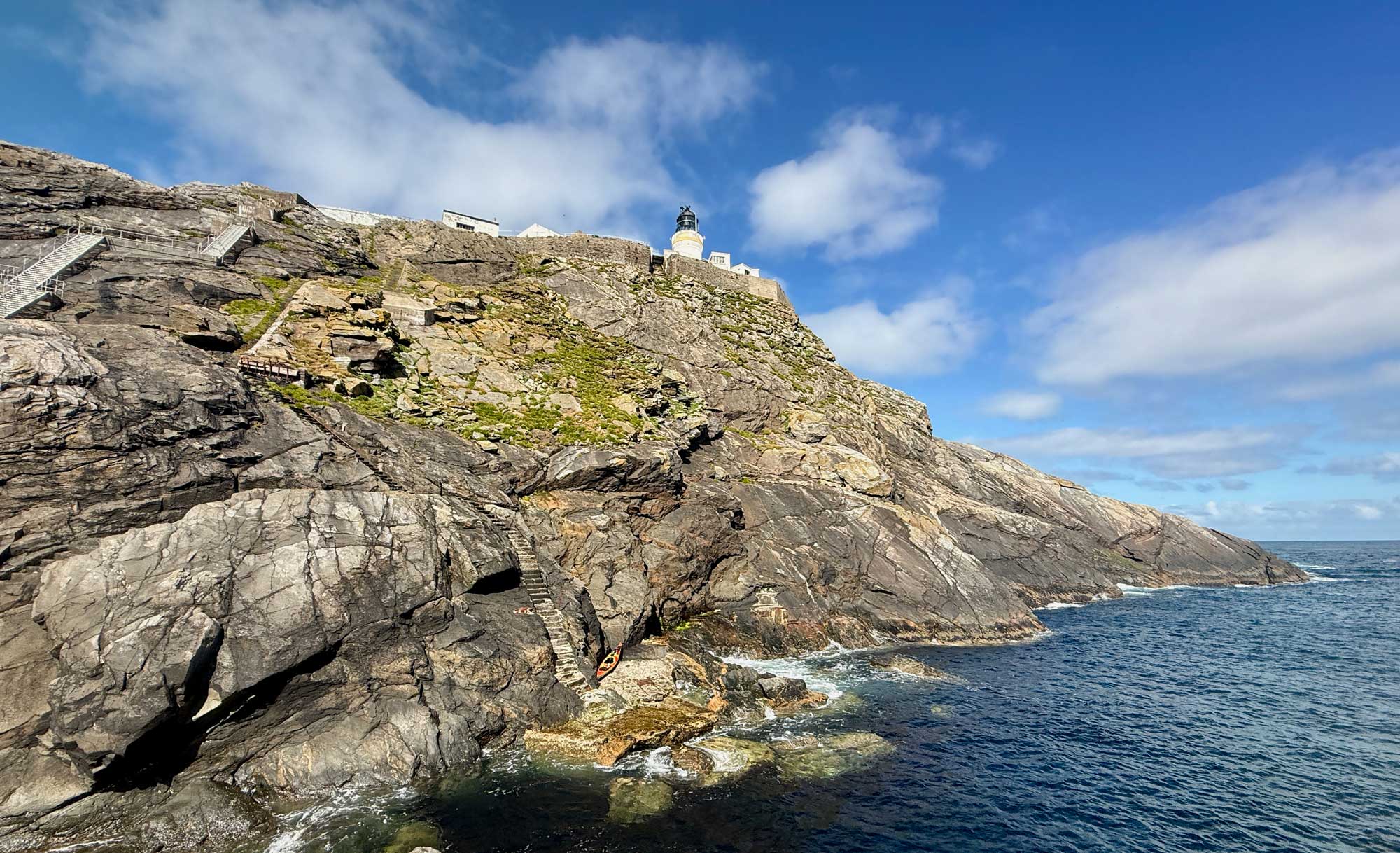
The landing, my Volan tied off temporarily before being carried up to the higher ledge.

With time to spare after the symposium, a rare weather window was apparent in the forecast; so, ferries were booked, and we headed to where the road ends, on Shetland’s most northerly island, Unst. It was a small window of opportunity, but with blue skies and sunshine, I headed off from the Lighthouse Shore Station with Muckle Flugga my hoped-for destination. Rounding Hermaness, the scale of the place became impossible to ignore. The Atlantic stretched away to the west, the North Sea to the east. Thousands of gannets wheeled overhead while relentless swell exploded against the cliffs. And this was considered a calm day.
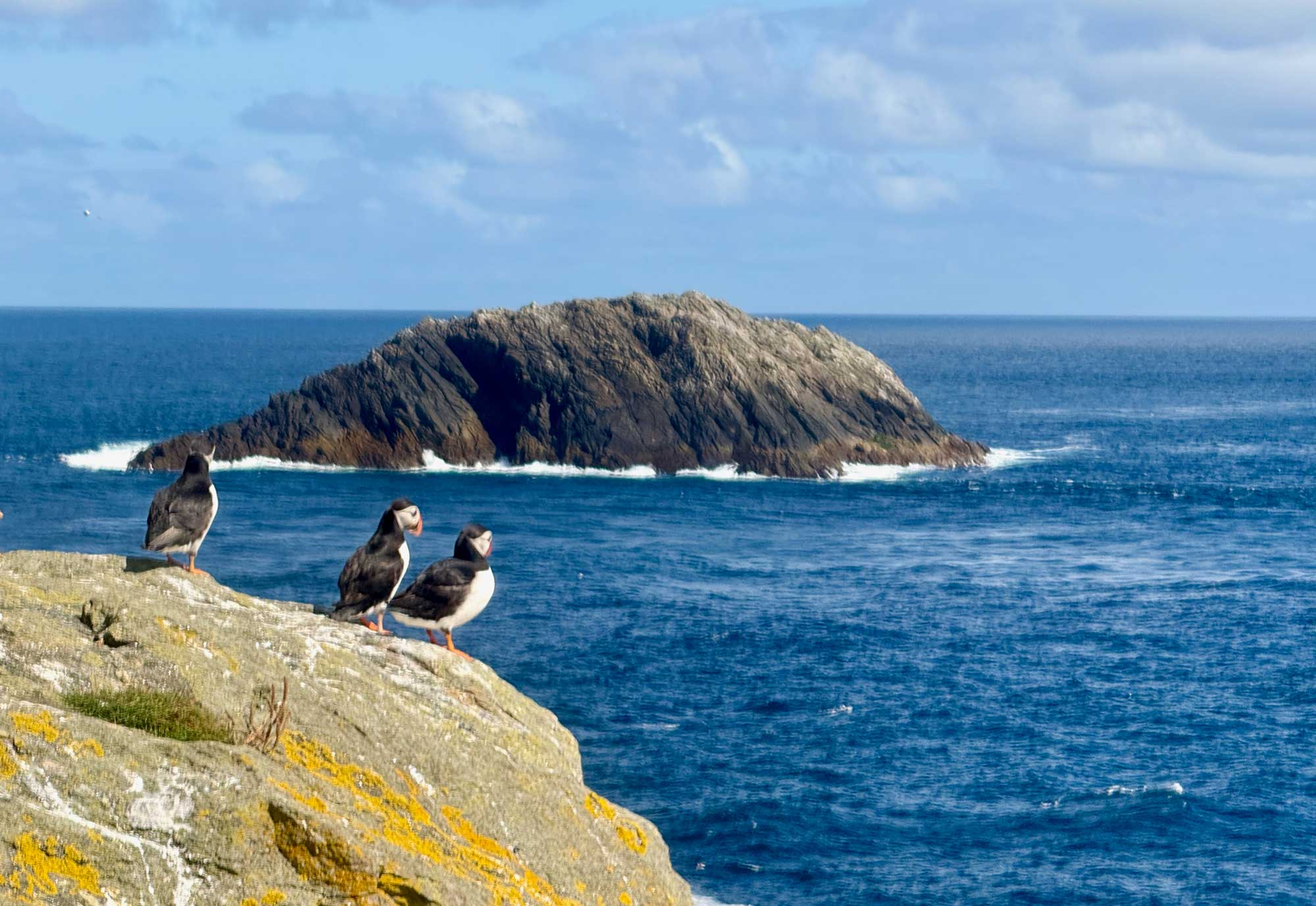
Puffins on route to the lighthouse; Out Stack, Britain’s most northerly point behind.

A kilometre offshore, the skerries that make up Muckle Flugga stood clearly visible, with the incredible lighthouse perched high atop the tallest skerries cliffs. Although only a short distance away, with up to 5 knots of tide, a funnelling Force 3-4 wind and the ‘small’ 1.4m swell, the crossing did not feel easy. Arriving in the lee of Muckle Flugga, sheltered from the wind and tucked into the tidal eddy, you’d think it was finally time to relax. It wasn’t! It was now time to find the notorious landing, which may or may not be possible depending on the swell and how brave I was feeling. Sitting beneath the old landing platform, I watched the swell. Every set mattered. Landing solo on Muckle Flugga isn’t something to rush, and I was weighing up whether I could get ashore without damaging either the kayak or myself. Eventually a gap appeared. Fingers crossed, I committed. A few seconds later I was standing on Muckle Flugga.
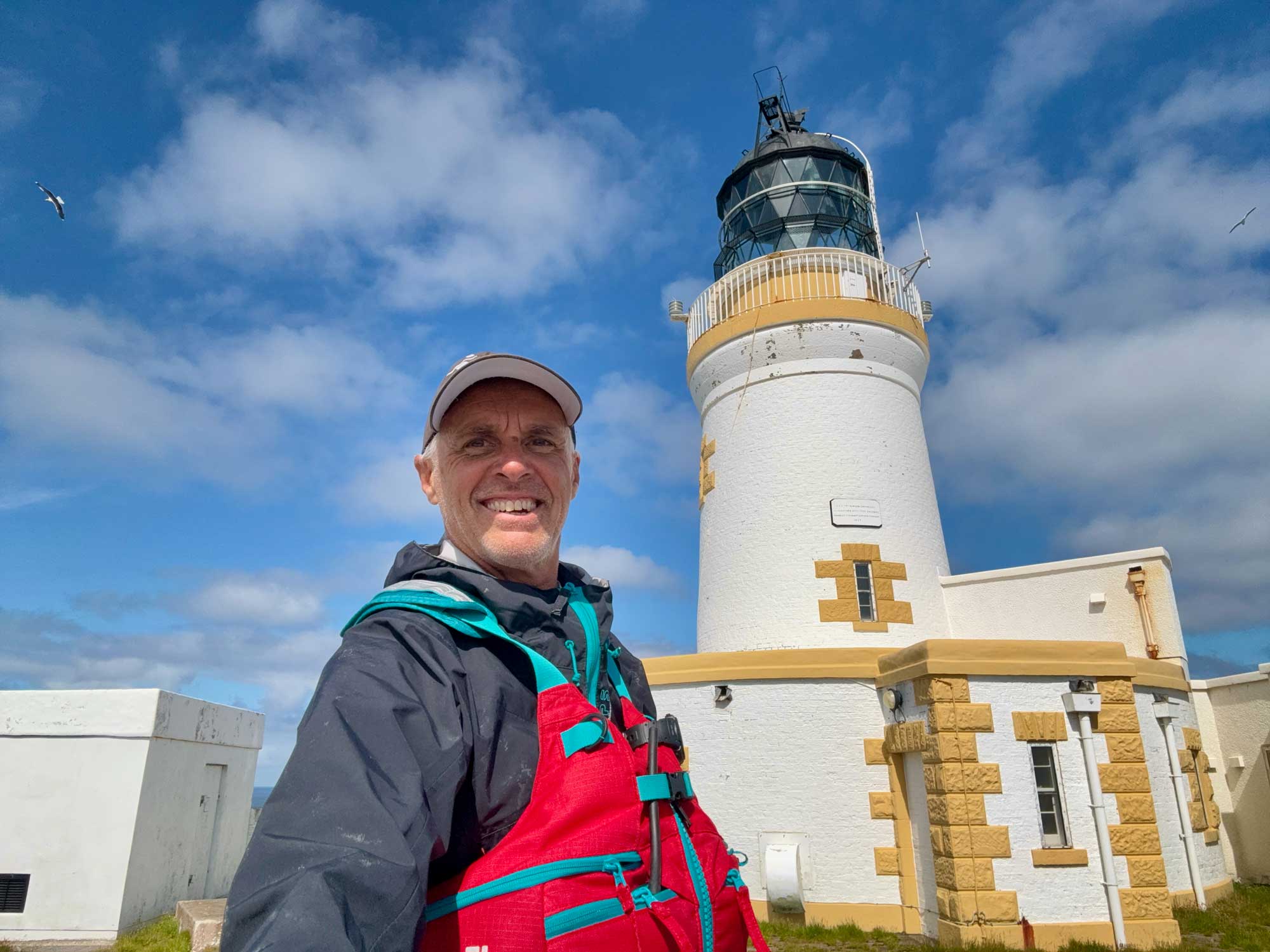
Muckle Flugga lighthouse – the wait had been worth it!

I was particularly glad to be paddling my Lightweight Volan. The first 30 of the 250 stone steps climb steeply from the landing to a ledge I wanted to carry my kayak up to, well above any incoming swell. With it safely secured, I could tackle the rest of the steep stone steps that lead to the lighthouse. It was an incredible, if slightly tiring, climb; passing numerous puffins, nesting fulmars and arctic terns en route. I arrived at the top of the steps to be greeted by the awe-inspiring Stevenson lighthouse, first lit in 1858. From here the views stretched south across Shetland and north into empty ocean. After years of waiting for the right conditions, I was finally standing at Britain’s most northerly lighthouse. It was time to take it all in and savour where I was, because it was without doubt somewhere truly special that not many have been fortunate enough to enjoy; particularly in the sunshine!
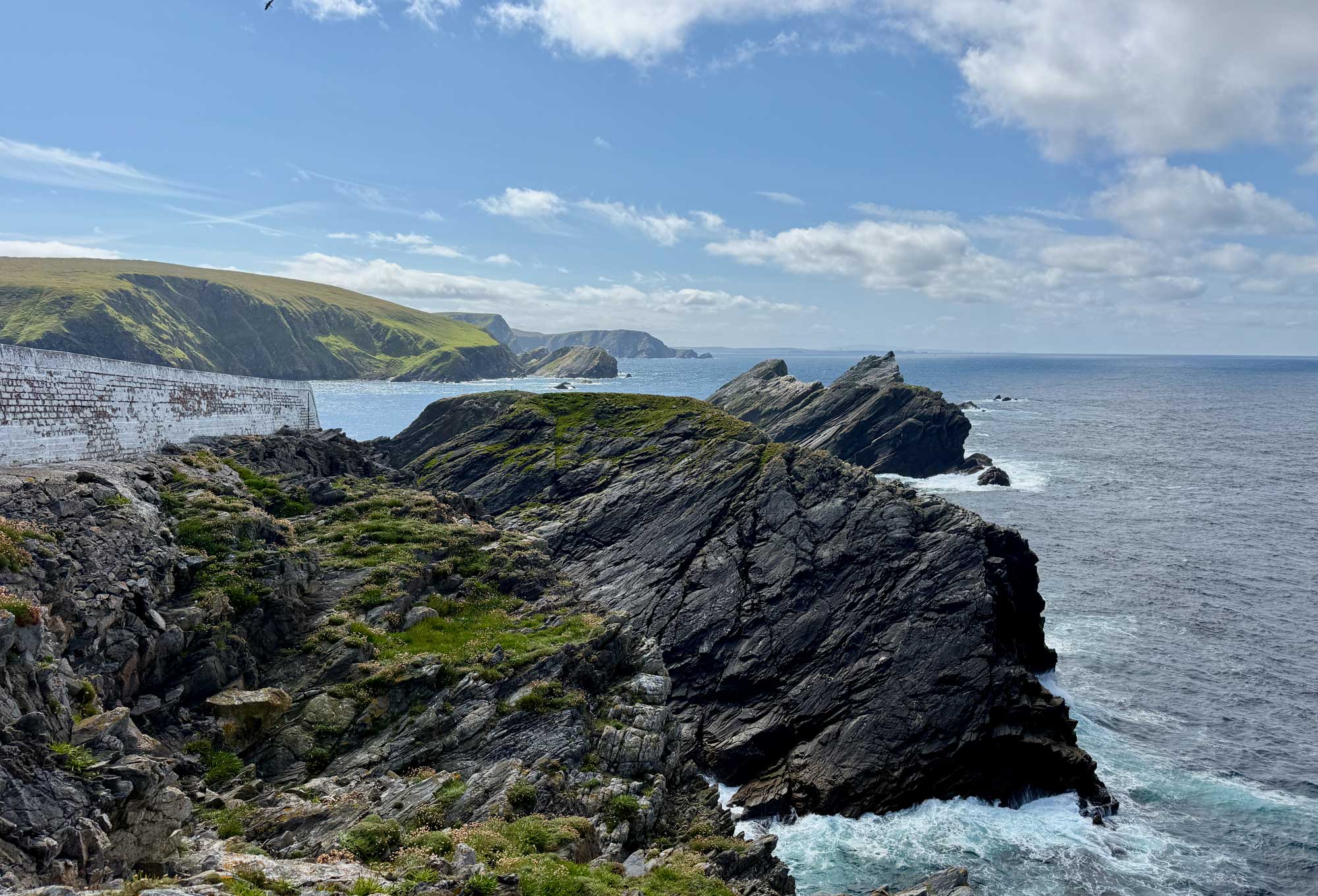
View from Muckle Flugga south to Unst and the rest of the Shetland Islands.

With the relentless swell refusing to abate, it was soon time to return down the steps to tackle the launching; it was all well and good getting onto Muckle Flugga, but to be successful I now had to get off! I was not allowed to leave easily, but despite a bit of sponging out required, boat and body were intact and head was dry; so, all was good. As the tide, wind and swell carried me back towards Unst, I found myself reflecting on what sea kayaks make possible. Some journeys are memorable because they’re difficult; others because they’re beautiful. Every now and then one manages to be both. Muckle Flugga had kept me waiting for many years, but in the end the long game was worth every moment.
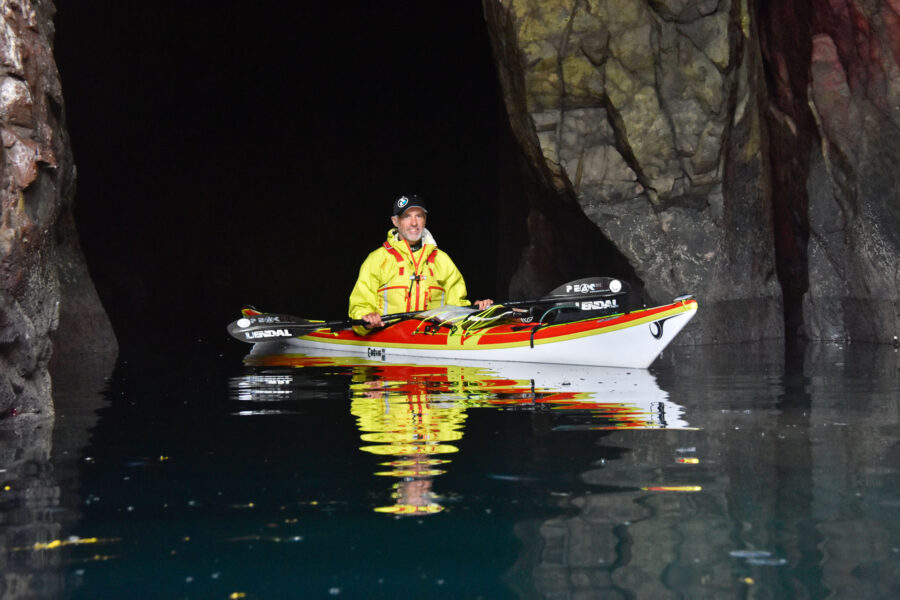
Scotland, the Northwest Highlands; the perfect expedition venue to take a Volan 160 and Cetus MV for an adventure…

Words by Doug Cooper

Photos by Doug Cooper & Pete Astles

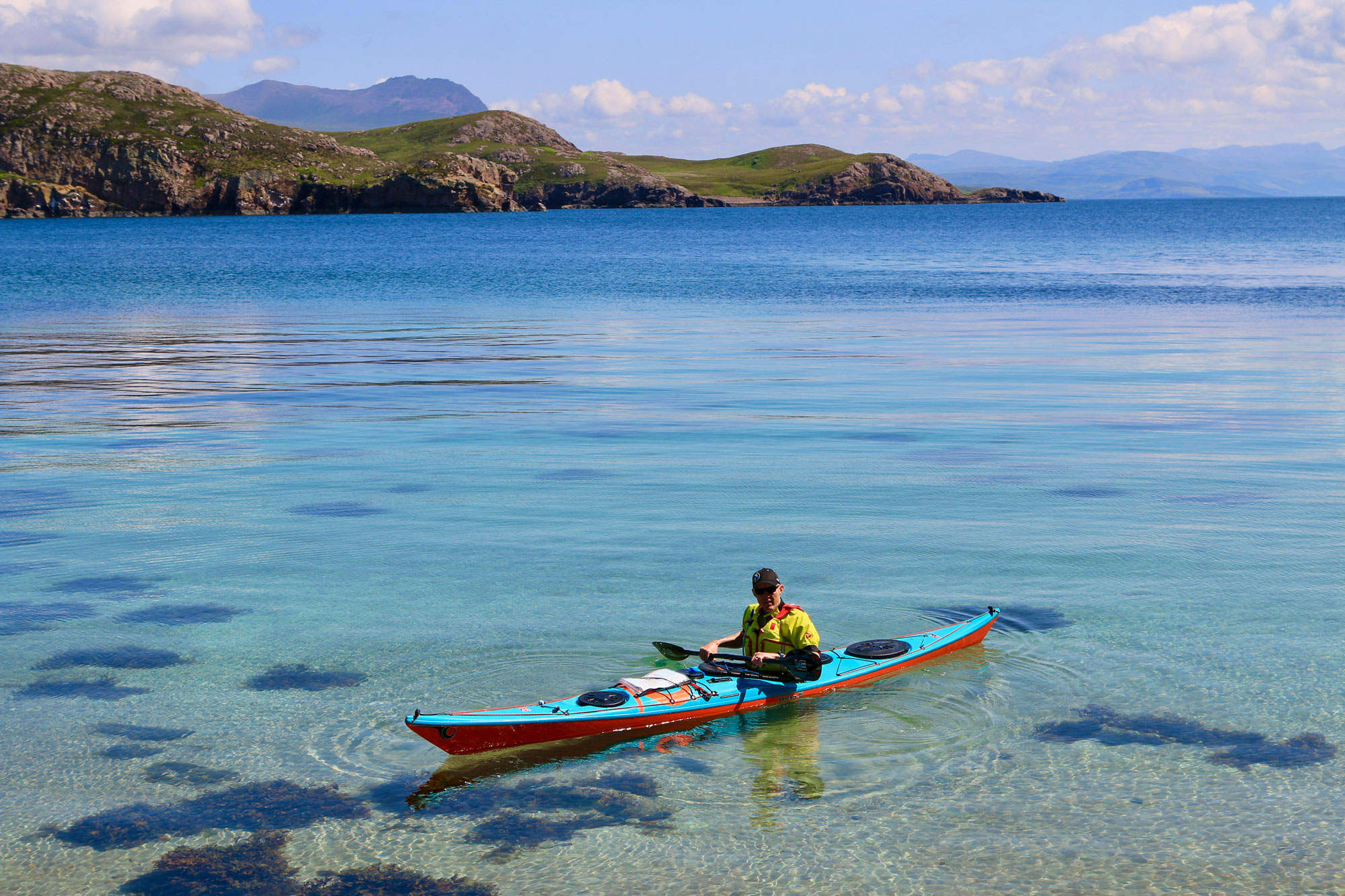
Every year, my good friend Pete Astles from Peak PS and I block out two weeks in our diary for a Scottish sea kayaking adventure – the primary aim is to get away from it all and have fun. Last year was no exception, and on a warm and sunny June day, we found ourselves in the Northwest Highlands just north of Ullapool on a stony beach, getting ready to set off for 8 days ‘away from it all’. It was that usual start of a trip; two big piles of kit sat alongside two empty sea kayaks, the two of us wondering if it would all fit! Kit for a self-support trip of this length is nothing we are not used to, but our trip was going to take us initially through the Summer Isles where water was scarce, so we needed to fit in extra water; alongside some of the extra comforts two slightly more ageing adventurers now look to take on trips!

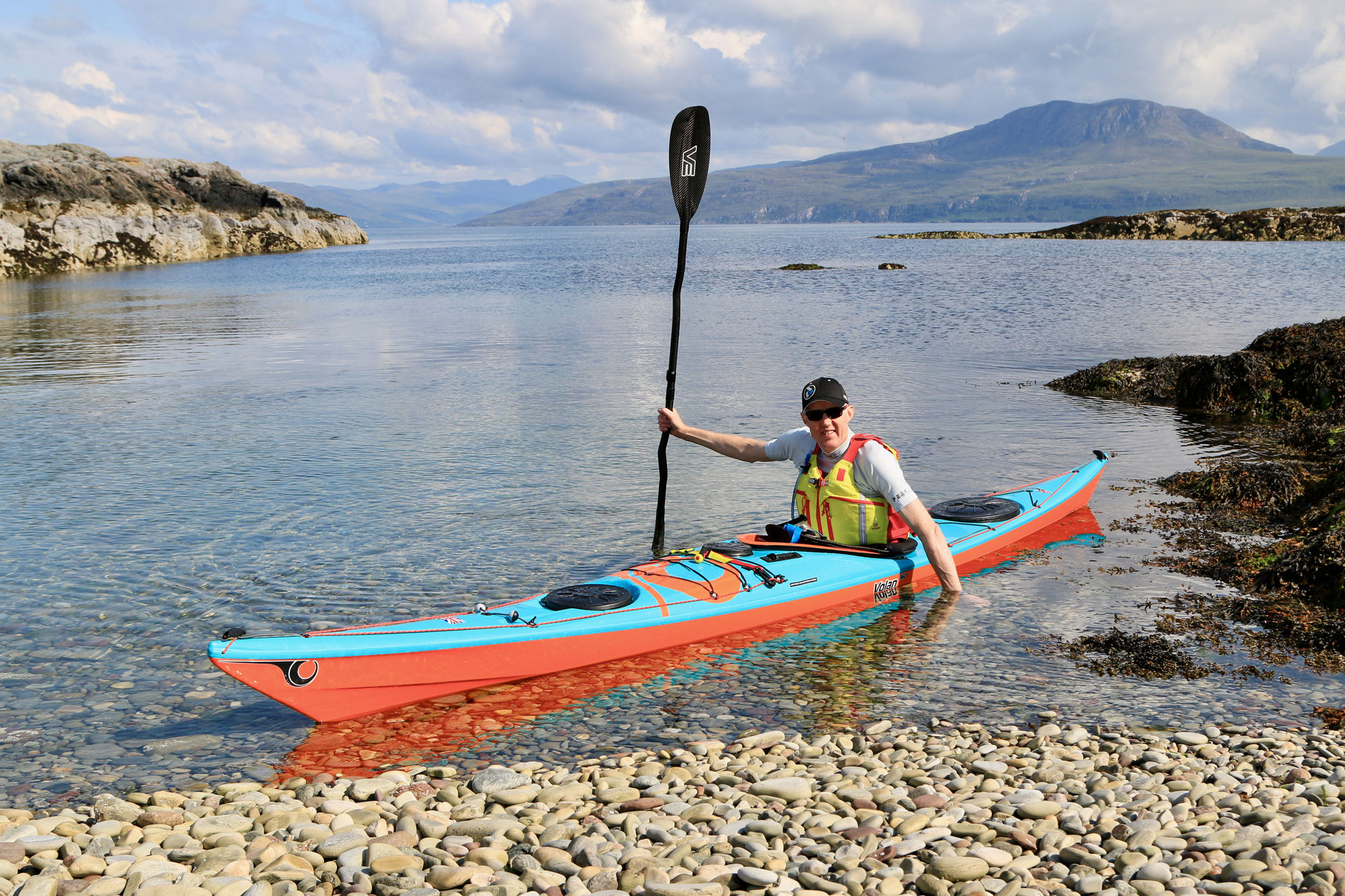
I was packing my trusty Cetus MV that I have paddled for many years now, but Pete was in a new Volan 160 that he was looking forward to trying out, and I was very interested to see how it’d compare with my Cetus! I must admit I was sceptical the Volan 160 would fit all of Pete’s kit in, but it passed this first test with flying colours – everything was in, and its carrying capacity seemed not too restrictive compared to the Cetus.

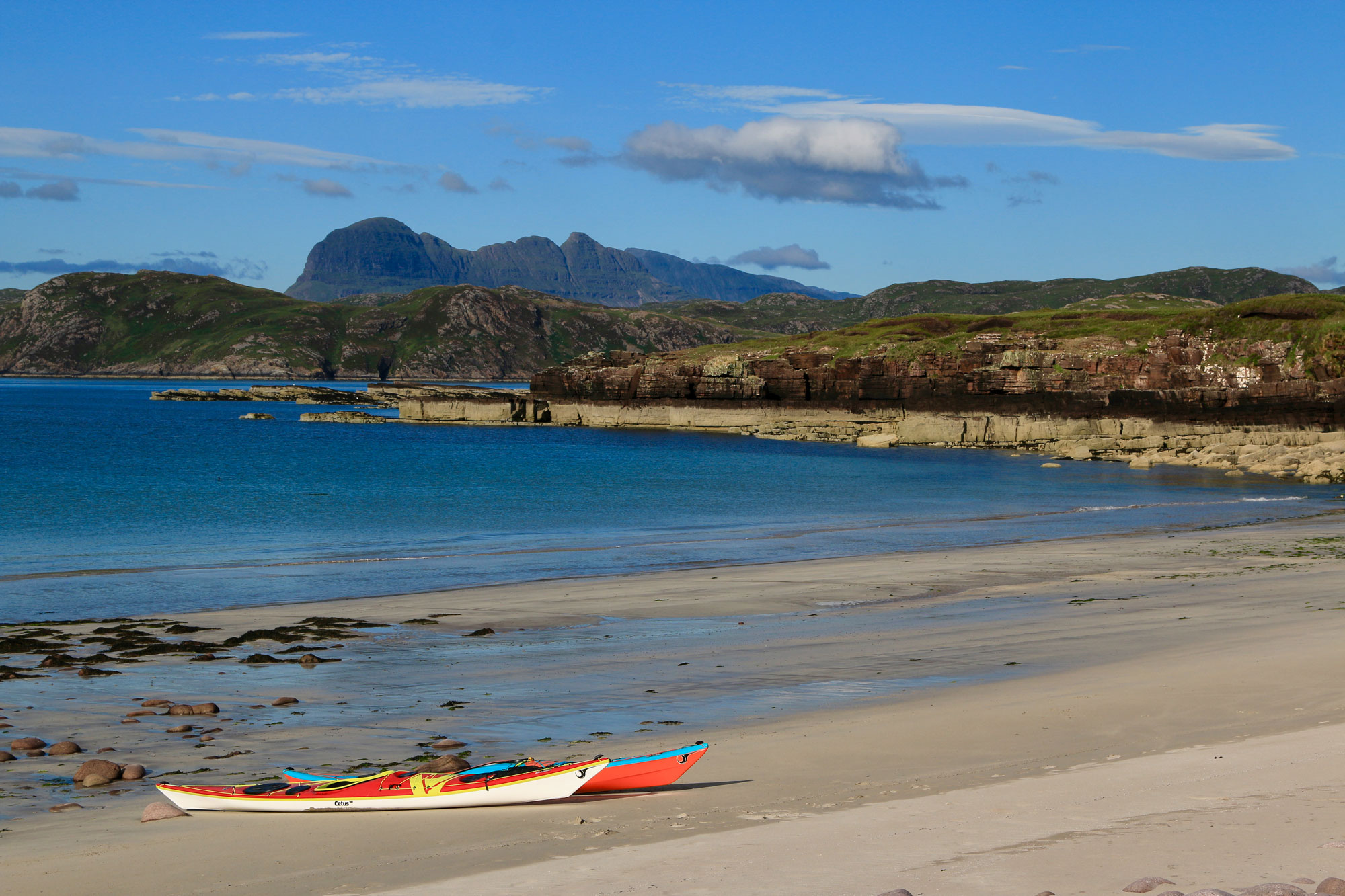
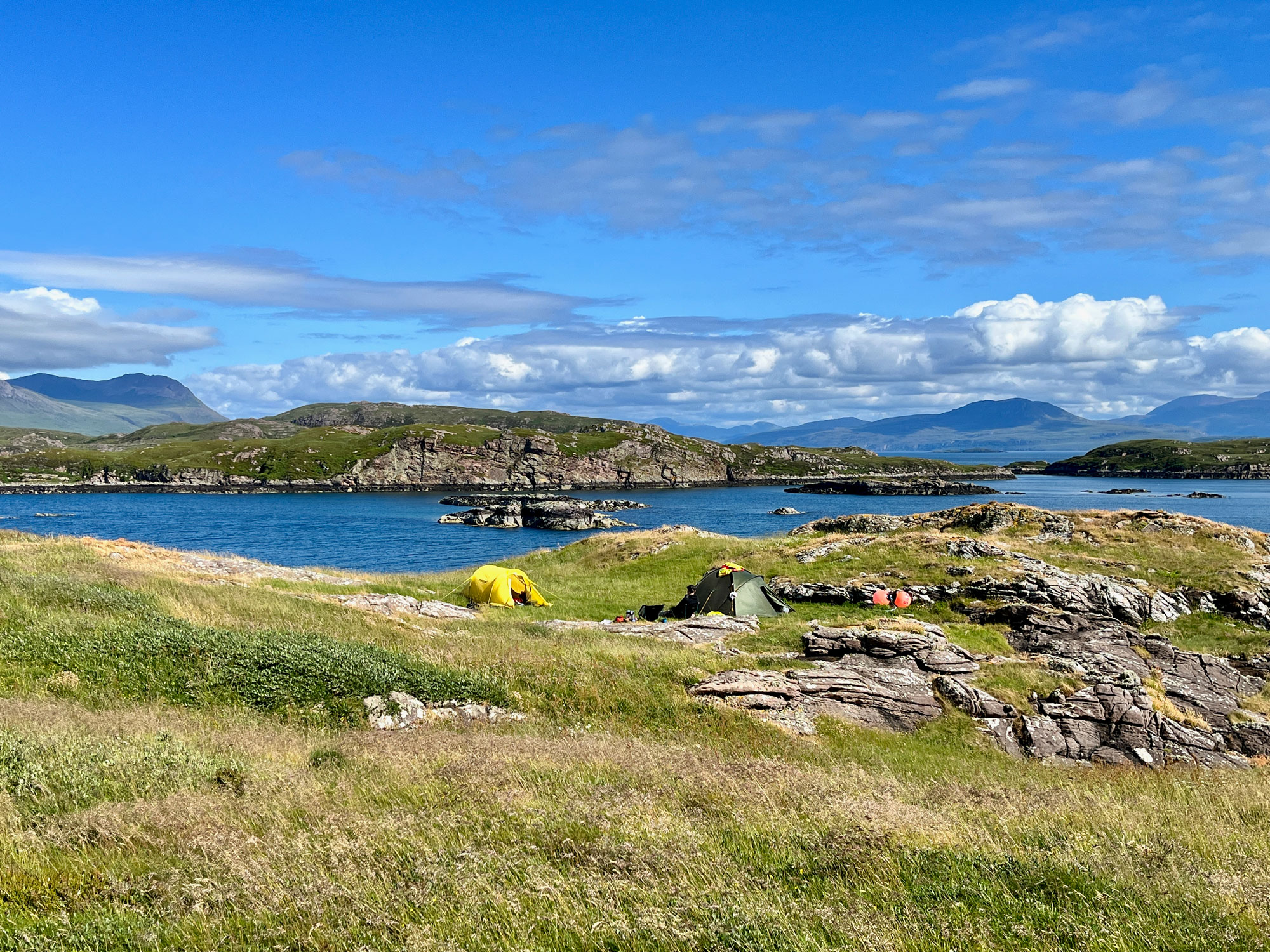
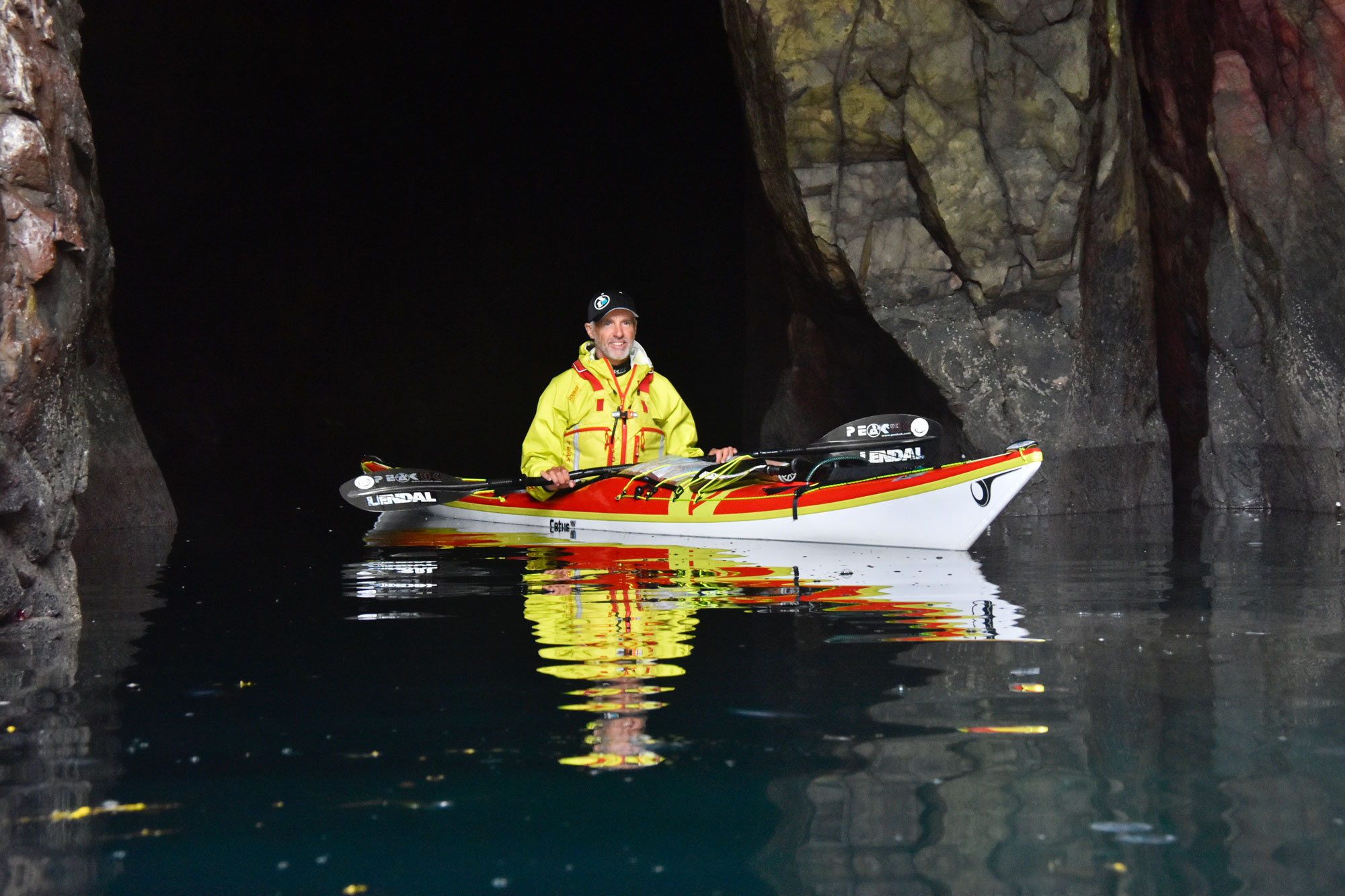
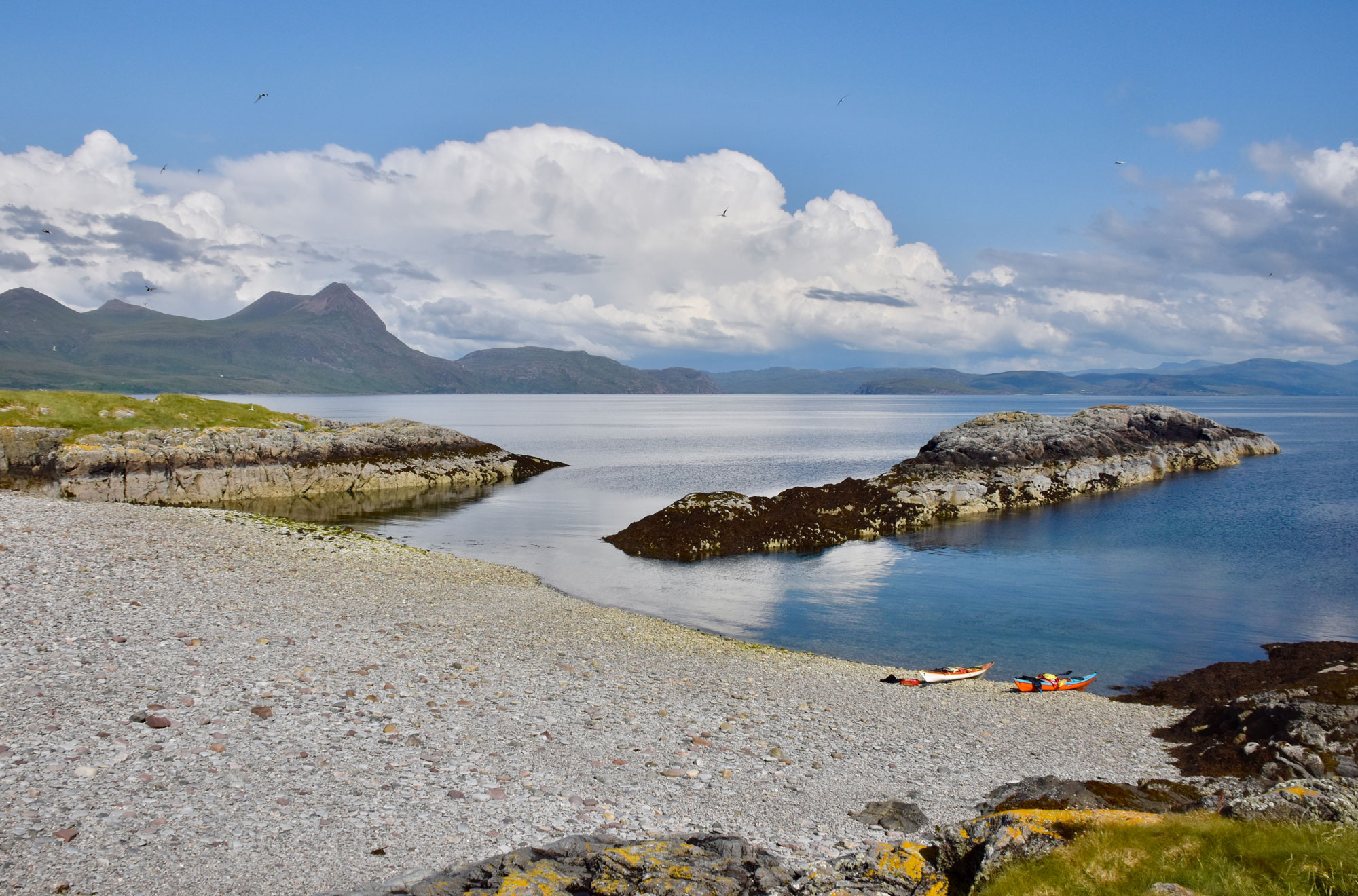
With perfect weather and a myriad of islands to explore, wild campsites to savour and breathtaking scenery to take in, we spent the next five days exploring every nook and cranny of the beautiful Summer Isles. Evenings were spent enjoying watching the sun set over the distant Outer Hebrides, whilst days were spent venturing between the islands, landing on the beaches, and exploring the caves; all under the watchful eye of the resident wildlife and the towering sentinels that are the surrounding Assynt Mountains.

Whilst exploring the islands, we decided to swap kayaks each day, both wanting to discover the performance differences between our two boats. In the calm conditions, both kayaks cut through the water like a dream, with the Volan 160 consistently surprisingly fast – how could this shorter and wider boat maintain its speed so well was our constant source of discussion; the anticipated ‘faster’ Cetus was not leaving the Volan behind that was for sure. Enjoying exploring the caves, arches, and rocks, the manoeuvrability of a kayak makes such a difference to the ease of what can be achieved; we both had to agree the Volan 160 top trumped the Cetus MV big time when it came to this!

Leaving the Summer Isles behind, our journey continued around the dramatic headland of Rubha Coigeach, with expansive views west to the Hebrides, north to Cape Wrath, and east into the mighty Assynt mountains, a sight to behold. A stunning beach provided our camp for the night, a perfect end to this magical day; however, with the sun setting, the forecast advised us all was to change for the next few days. Waking to a sea of white horses, we planned a conservative route to take us ever north, where we planned to finish at Lochinver. Setting off, we enjoyed a ‘playful’ force 5-6 to get us going, but by the early afternoon, this had evolved into a ‘robust’ force 7-8, and thus, a downwind surf to shelter was required.

The ‘playful’ and then ‘robust’ conditions again provided a great opportunity to test how the two kayaks performed. It was obvious that the Cetus MV tracked a bit better in the side winds, but that said, with appropriate trim and skeg, the Volan 160 was certainly easy enough to keep on track. When the robust conditions asked for stability, manoeuvrability, and confidence-inspiring from the kayaks, then neither let us down. That said, in the Volan 160, it was obvious less effort was required to turn in the conditions, and there was definite extra stability to allow for a slightly more ‘relaxed’ as opposed to ‘focussed’ look on our faces! As for the Force 8 downwind surf – well, that certainly put a big smile on both our faces in our respective craft. However, when it came to cutting about on the following sea waves, the Volan 160 won the price for minimum effort and maximum style, but when it came to getting to the shore first in a straight line at speed, the Cetus MV was there to welcome the Volan ashore!

June in the far Northwest Highlands provides close to twenty-four hours of daylight, so, having sheltered from the wind all afternoon, we could make use of a late evening calm period to continue our journey. Our last camp was on the outskirts of Lochinver, where the following morning we could catch a bus to return us to our car. After our brief stormy period, it provided a tranquillity that could be savoured more than usual as we sat and watched the sunset one last time. It allowed us to reflect on our 8 days ‘away from it all’, chat about sights seen and experiences lived, and, of course, most importantly of all, plan where we will head for the following year’s two-week adventure – already in the diary. The final question to ponder, will I be joining Pete in paddling a Volan 160 for the trip – I think I might be!

A Short Paddling Trip to Scotland (and a Lot of Cake)

Now, I’m far from being a seasoned sea kayaker, in fact, I’m actually a whitewater kayaker, but when the opportunity came up for a few days of exploring in Scotland with good pals, I wasn’t going to turn it down!

For anyone here that’s also a whitewater kayaker, you may know that I’ve been fortunate enough to work all over the world with TV wildlife presenter, Steve Backshall. It was a big birthday for Stevo this year, and we wanted to make it a memorable one.

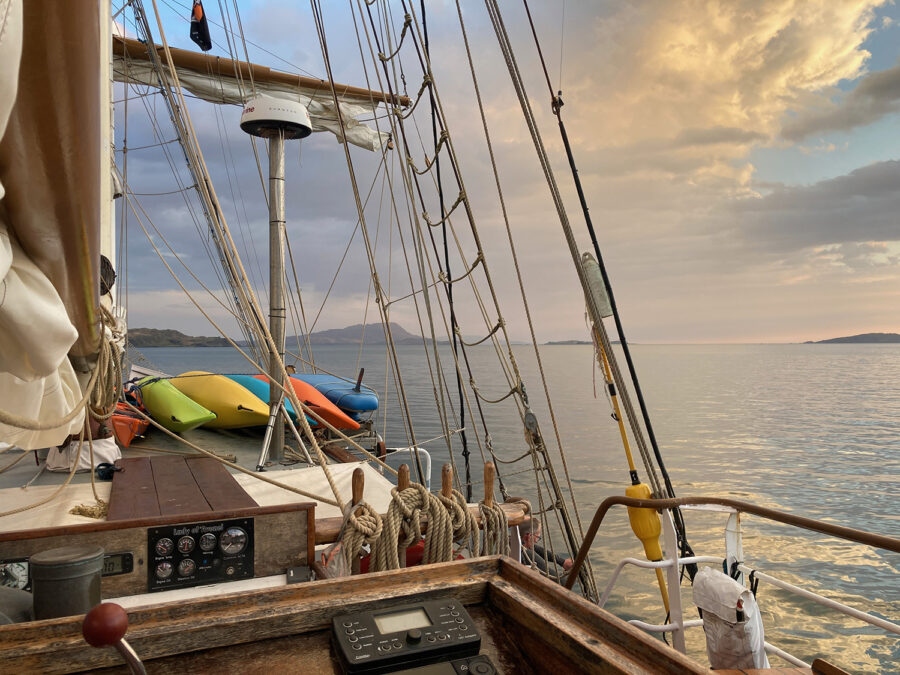
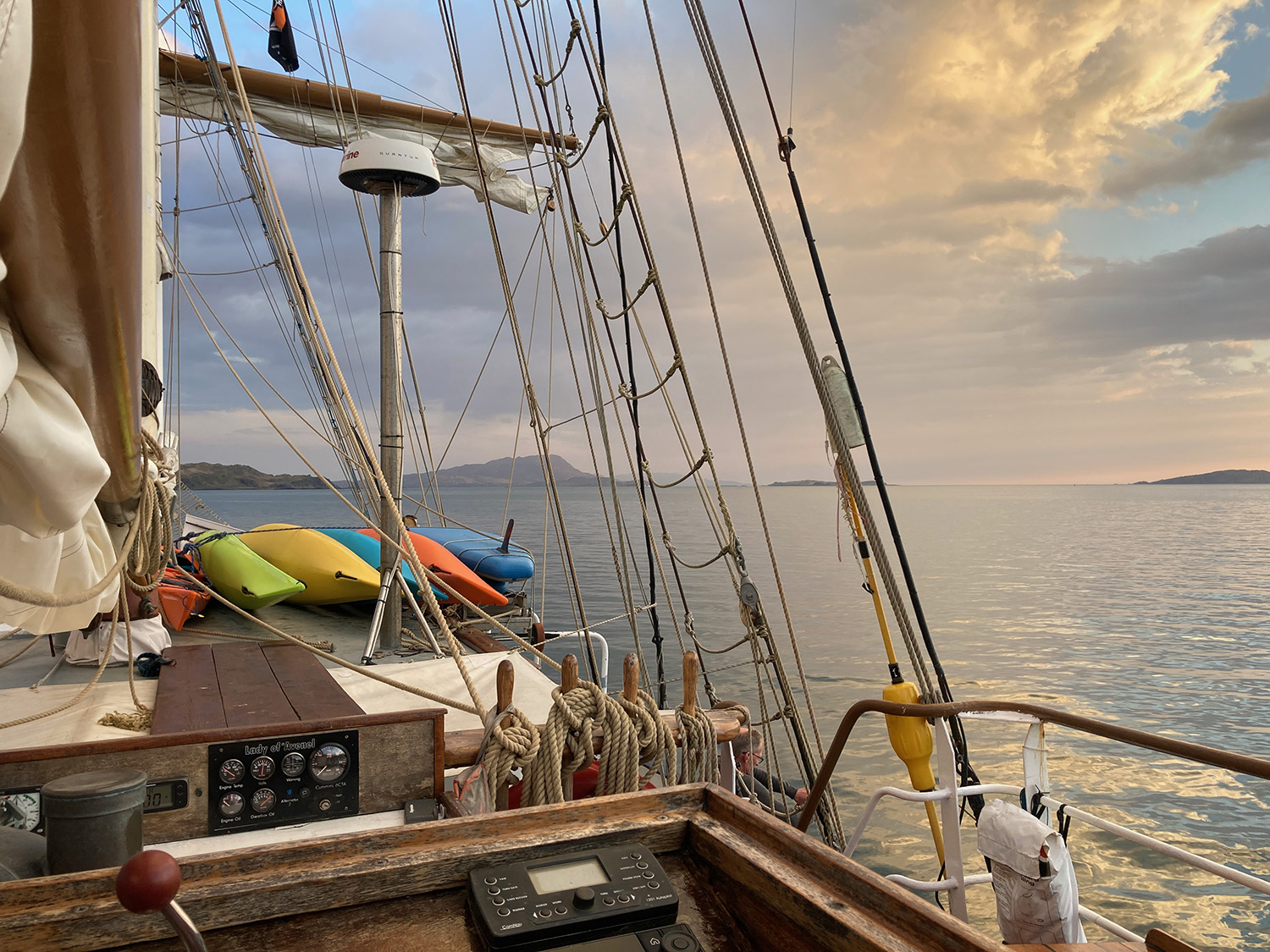
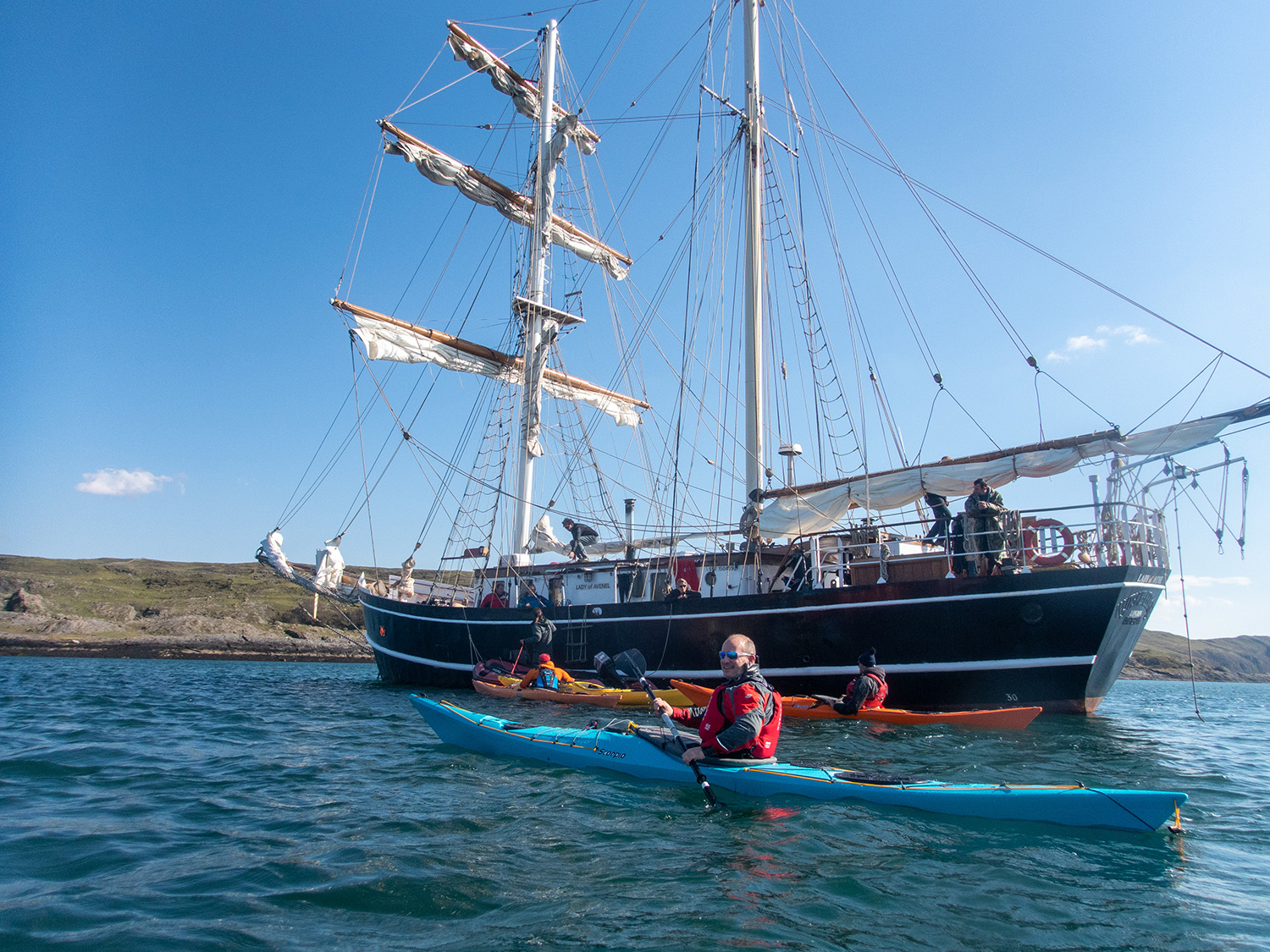
This would be unlike any trip I’d done before, mainly because a beautiful 102ft sailing boat known as Lady of Avenel would be our home for the next couple of days. Not only was this an amazing treat, but it would also allow us to paddle and explore to our heart’s content. Stefan Fritz owned the Lady and would be our fantastic skipper, accompanied by friend of the ship, Patrick Winterton (of Scot Ocean Sports), who had kindly offered to join us, sharing his local knowledge and expertise, as well as excellent company!

Unlike our usual missions, the aim was not to conquer anything big and gnarly, discover unknown territories, or document grizzly bear behaviour, it was simply to have fun with friends, paddling somewhere new -and that’s exactly what we did!

Day 1
Our adventure started from Dunstaffnage marina, near the town of Oban, and as always, began with a healthy chunk of kit faff. It appeared that the vital bag of PFDs and breakdown paddles was sitting on Steve’s driveway almost 500 miles away. Steve 1 blamed Steve 2 (Backshall) and Steve 2 blamed Steve 1. Thankfully we managed to beg, borrow, and steal enough gear for everyone and were finally sailing out of the marina, accompanied by some playful porpoise!

We were heading towards the Isle of Lismore, or Lios Mòr, which is thought to mean ‘Great Garden’ in Gaelic and relates to the green and fertile lowlands on this small, Inner Hebrides island. About 180 people live on the 10-mile long by 1-mile wide island, as well as a rich population of seals, otters, peregrine falcons, and razorbills.

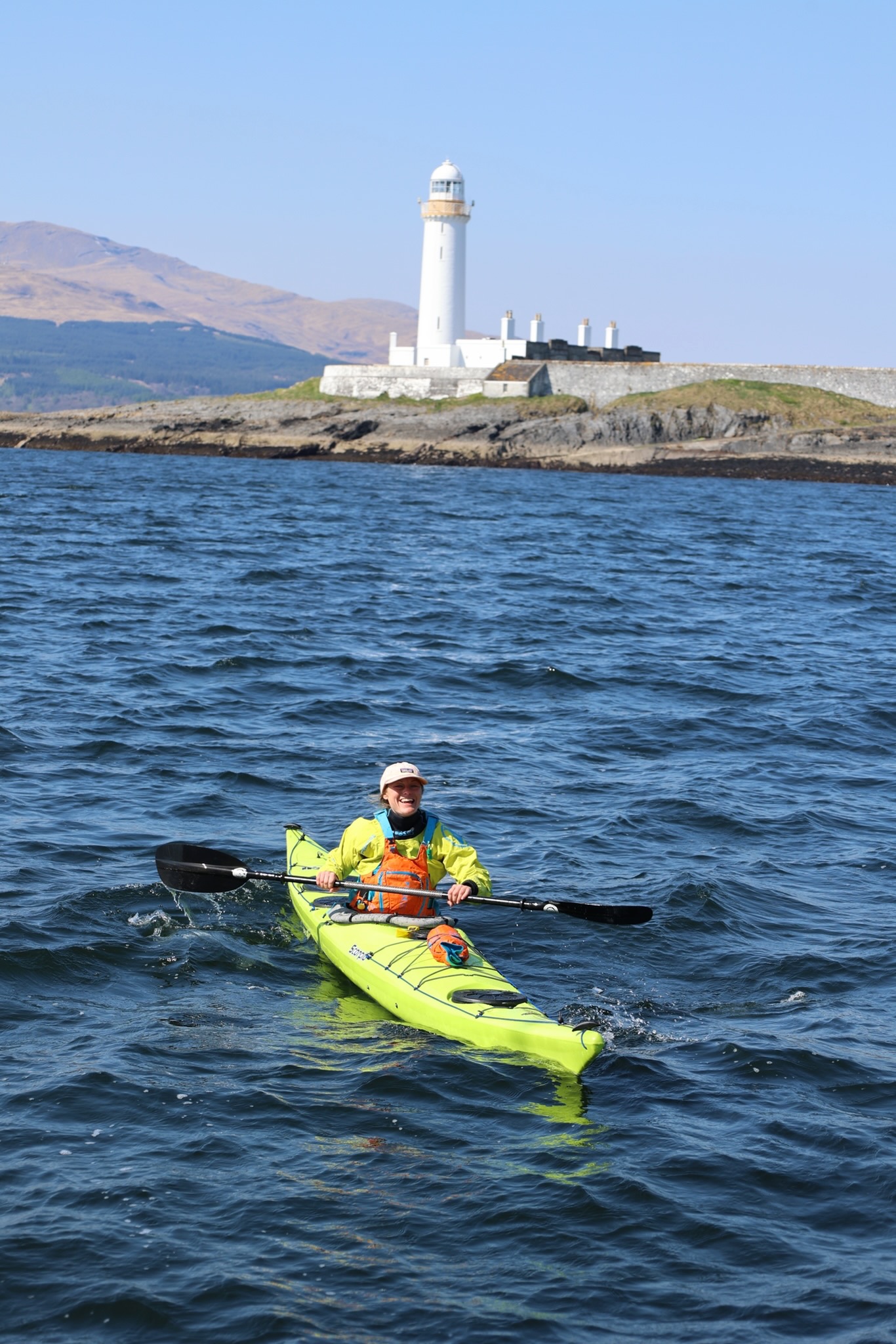
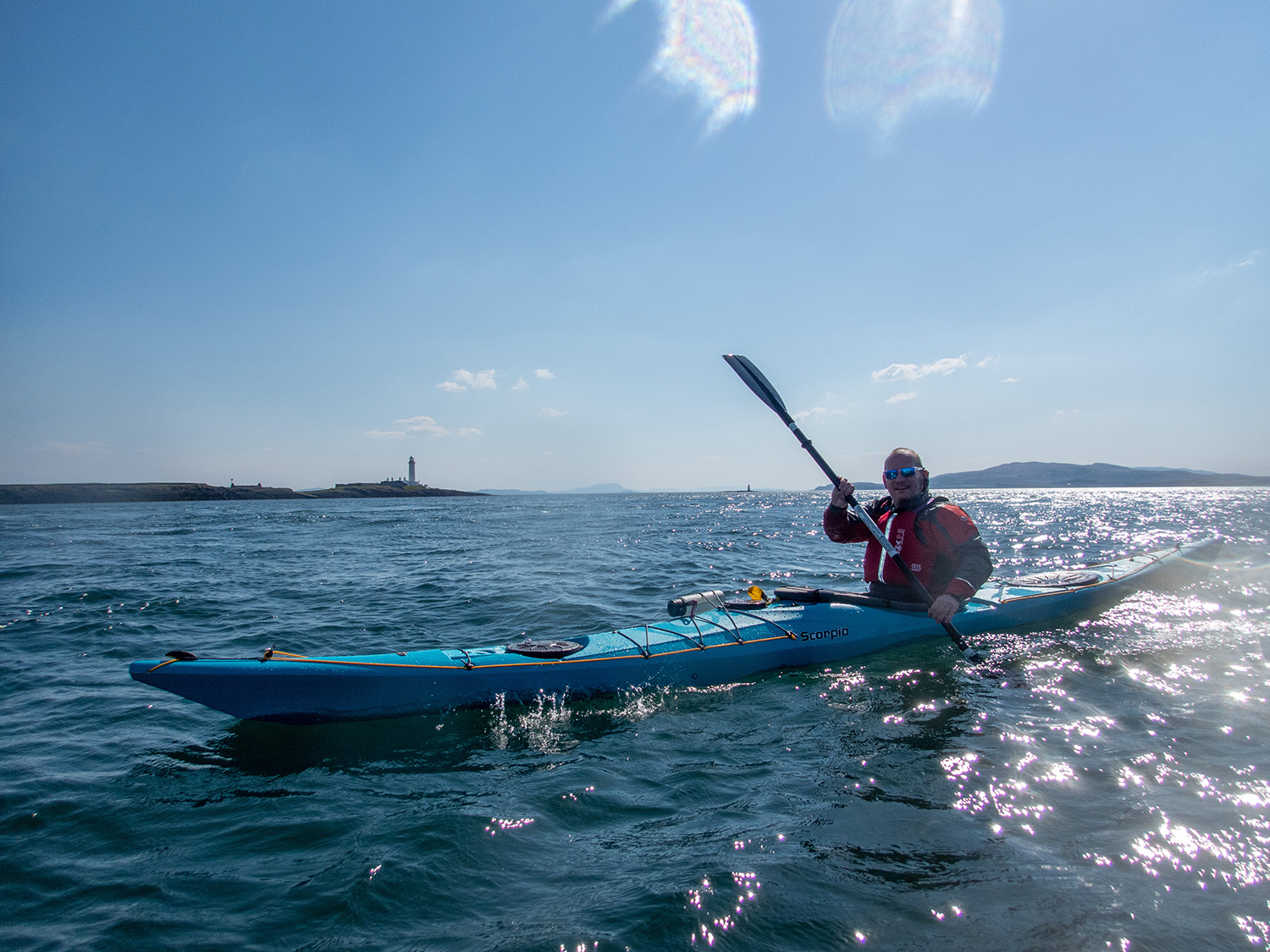
With the Lady’s anchor down, we set off in our sea kayaks past the tall, white Musdile lighthouse in calm waters and glorious sunshine, surrounded by black guillemots and squawking seagulls. Continuing west, we passed a small skerry known as ‘Lady’s Rock’, before reaching Duart Castle on the Isle of Mull. It was here that Patrick told us the gruesome, but slightly comical story behind these landmarks and how this seemingly indistinct skerry got its name…

Way back in 1527, a rather unpleasant chap called Lachlan Maclean of Duart rowed his wife, Lady Catherine Campbell to this tiny chunk of rock in the sea, leaving her there to drown once high tide came around. Looking out from his castle window the next morning and seeing no life, he announced Catherine’s death. The plan backfired somewhat when his conversation with
Catherine’s family about the ‘terrible illness’ that took her life was abruptly interrupted by the Lady herself walking into the room and joining them at the dining table!

After a quick stop in the bay at Duart Point, we crossed northeast through the Bernera gap and along Lismore’s west coast -where lots of seals were either sunbathing on the beach or bobbing up beside our kayaks! We then rejoined the ship and crossed from Lismore to Port Appin on the mainland.

We pulled in at Airds Bay, where we were met by seals enjoying the evening sun and a bagpiper playing happy birthday for Stevo -a surprise we’d set up with the help of skipper, Stefan! The anchor went down and a night of celebrations followed, including two very large cakes.

Day 2
The Lady sailed us from Airds Bay to Kerrera Island, which at 7km long and 2km wide is home to approximately 70 people. Two communities exist on the island- north and south, and a road connecting the two was only developed a couple of years ago!

Life on Kerrera is not for everyone, especially as residents have to travel to mainland Scotland for everyday basics such as schools, shops, post offices, banks, and health services; however, it boasts some of the best highland island views, which we got to enjoy until we reached just north of the Slate Island of Siel. Here we launched the sea kayaks and paddled the relatively narrow sea channel between the island and the mainland (only 12km between the two) and under the ‘Bridge over the Atlantic’ (Clachan Bridge).

It had been relatively calm and sheltered as we paddled through the Sound of Siel, but as we etched further south the wind really started to ramp up. Rounding the southern tip of Siel, the increasing wind put an abrupt end to our noisy chatter and banter, instead adopting the ‘head down and paddle’ approach! This was amplified even more so when we met the boiley currents of the Sound of Cuan and even stronger winds.

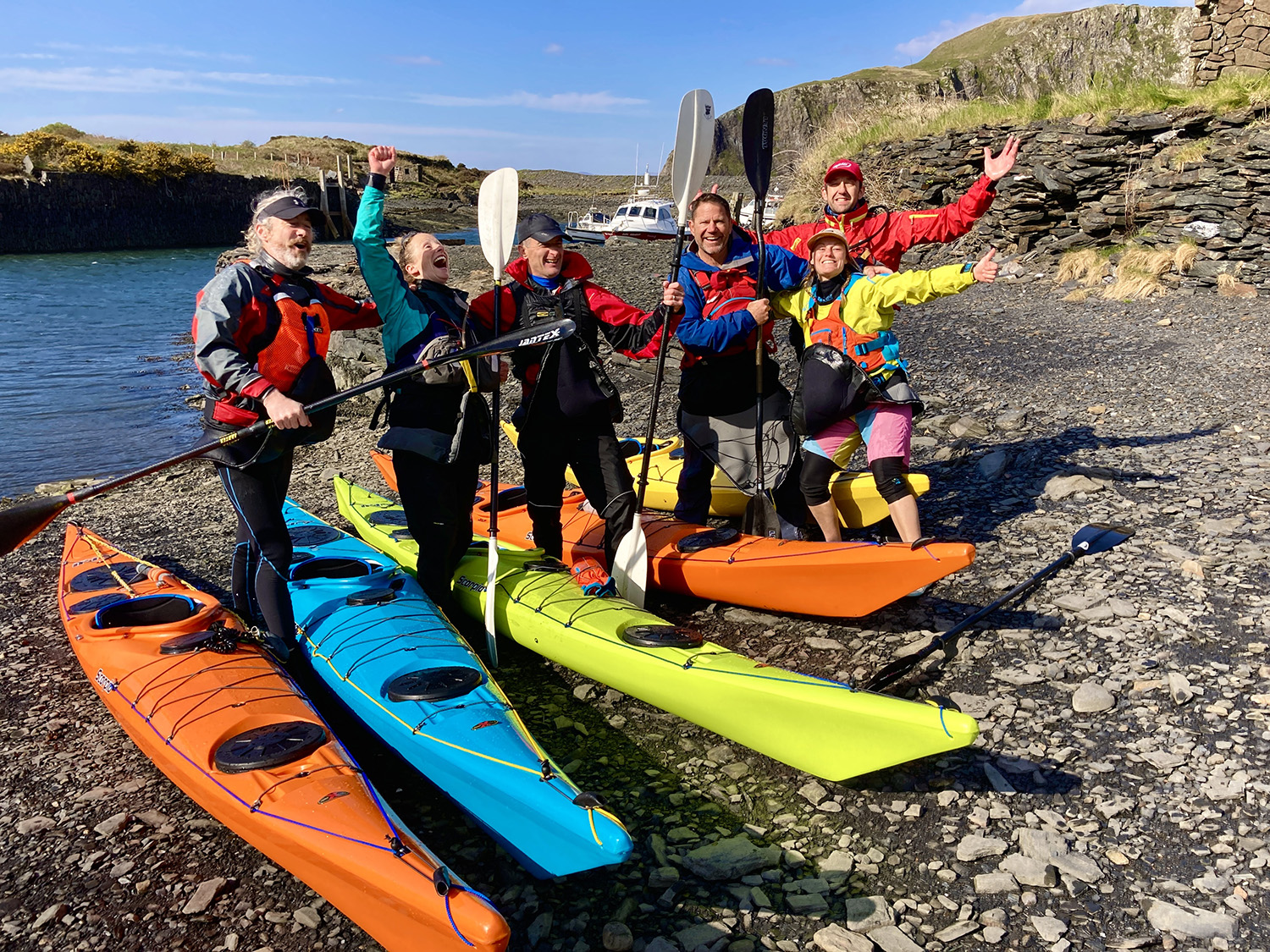
After the gruelling gales and confusing currents, Patrick waved us over to a small harbour in a tiny village called Easdale. Earlier that day, we’d all thought that he’d been joking when he talked about World Rock Skimming Championships. However, it turns out that this is actually a thing and
this is where it’s hosted each year. Patrick announced that we weren’t allowed to leave Easdale until we had at least one round of competition.

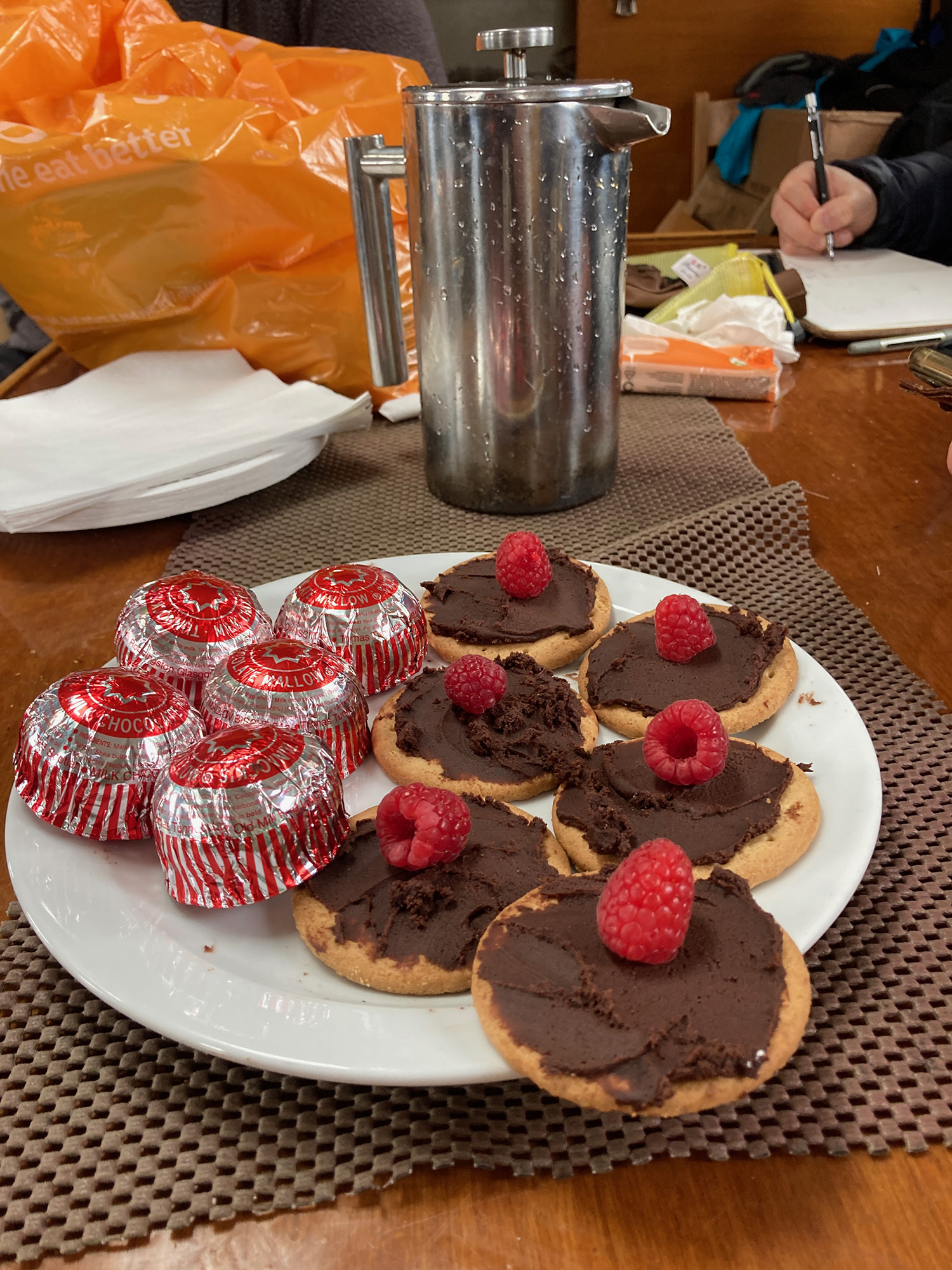
Obviously, Patrick was a regular here, as his rock skims pretty much covered the entire length of the natural pool. After some embarrassingly bad attempts on my behalf, we got into our kayaks and back into the wind, spotting several Oyster Catchers with their long, orange bills and loud ‘peeping’ call, along the way. By the time we rejoined the Lady, everyone was ready for a cup of tea and of course, more cake.

By the evening, the winds had died down and the Lady made her way back up to Kerrera. Here we enjoyed one last night all together (with more cake), before getting up early for a day of sea swimming and journeying back to Oban.

There are over 40 islands making up the Inner Hebrides islands and we’d only scraped the surface, leaving plenty to come back and explore another time. We’d been limited to just a couple of short days here in Scotland, but we all shared the feeling that we’d had so much during that time. Everything from glorious sunshine to storms and strong winds; calm seas to confused currents and spinning whirlpools; porpoises, seals and lots of sea birds; kayaking, swimming and sailing; laughs, banter, long overdue catch-ups; and of course, a lot of cake.

Thank you, Scotland and we’ll be back soon!

Huge ‘thank you’s go to Steve and the crew for a very fun and memorable trip; S1 for driving and putting up with me for two very long car journeys; Stefan, Jules, and Samantha for looking after us so well on the Lady of Avenel; Patrick of Scots Ocean Sports for the local knowledge, guidance, and excellent company for our sea kayaking explorations.

Images: Steve Backshall, Rosie Gloyns, Keith Partridge, James Brickell, Sal Montgomery

The Summer Isles

Having spent much of lockdown reminiscing on past adventures and planning exciting new adventures (the shelf of guidebooks has had to bear the burden of a few new additions since March), we were ready to make the most of the easing of restrictions. One of the new additions to our guidebook collection was Doug Cooper’s Skye and North West Highlands Sea Kayaking. In hindsight, it seems remarkable that it wasn’t already an established and well-thumbed favourite.

With kayaking, adventures, and overnight stays more than 5 miles from home all back on the cards, a plan was forming. It seemed that high pressure was going to dominate the North Coast for at least a few days, and after our enforced time away from the water we wanted a series of day trips with the option of an overnight camp or two.

“A week could easily be spent exploring this area, let alone the islands further south.”
– Doug Cooper on the northern-most of the Summer Isles.

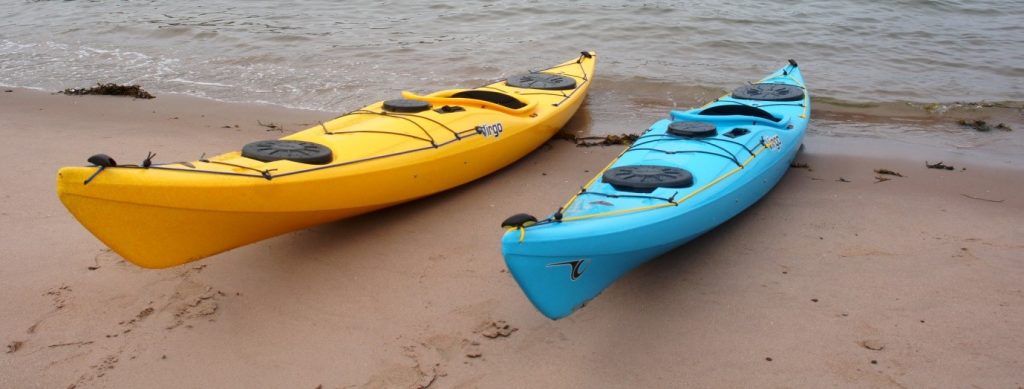
Our plan for a few day trips around the Summer Isles and an overnight camp now formed, the P&H Virgo seemed like the perfect choice: In CoreLite X it would be light for daily lifting on/off the roof of the van; rugged for lots of rocky landings and if the swell picked up some rock hopping; big enough to accommodate our camping kit; maneuverable to allow us to explore the tightest of gaps.

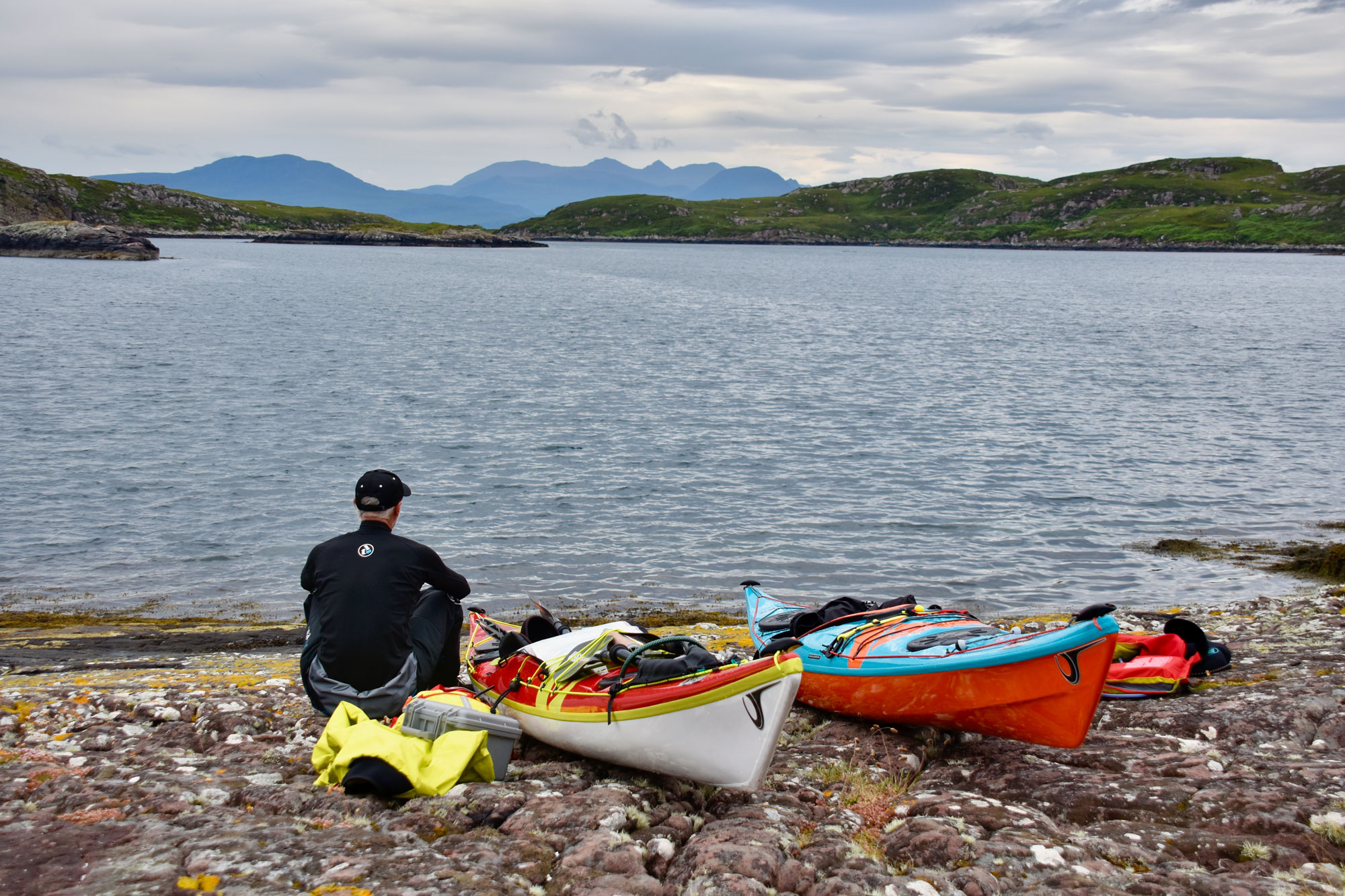
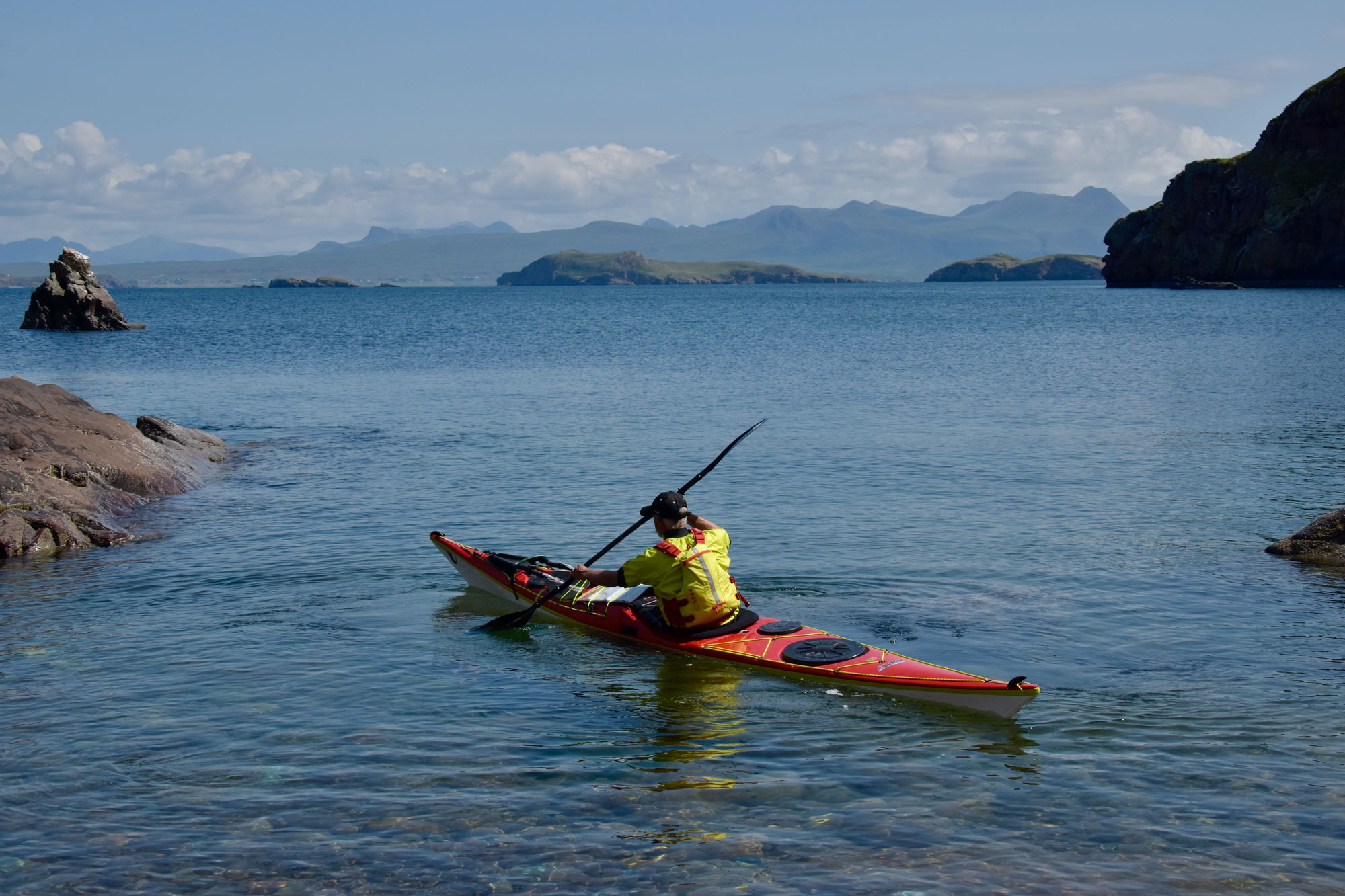
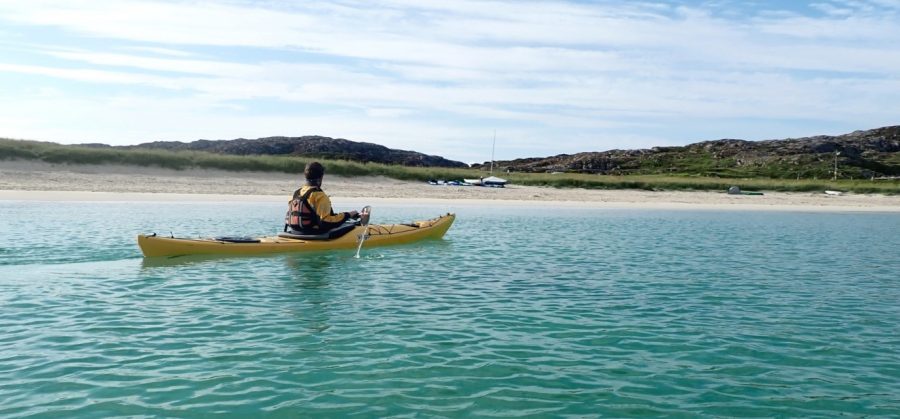
The first few days were spent making day trips in Loch Ewe and around the Summer Isles. Rocky coastlines with imposing cliffs, white sandy beaches, small bays and inlets, crossings up to 8km all with a beautiful mountainous backdrop, crystal clear water and wildlife aplenty. Midway through the afternoon on our second day, as we emerged from the mist and confirmed that we had followed our bearing correctly, found a sheltered cove for a rest and bite to eat, it became clear that our lives were to become richer in two ways. Firstly the Virgo, and secondly the North West coastline that we had been exploring.

Having covered nearly 100km in the first 3 days, it was time for a slower pace for a few days. Boats loaded with overnight gear we set out from Achnahaird beach to explore the coast of Enard Bay, following the rugged coastline as far north as the Bay of Stoer. With a brisk wind blowing offshore we slowly made our way north, in and out of the countless smaller bays and between the smaller islands. Our Virgos continued to impress us, never feeling as cumbersome as some larger boats do when carrying enough chocolate spread, cheese, and biscuits to see us through. Having spent time getting up close and personal with the many seals on Soyea Island on the outward journey we took a break on islands of Fraochlan and Eilean Mor, the perfect vantage point to watch the large pod of dolphins leaping in the middle of the bay.

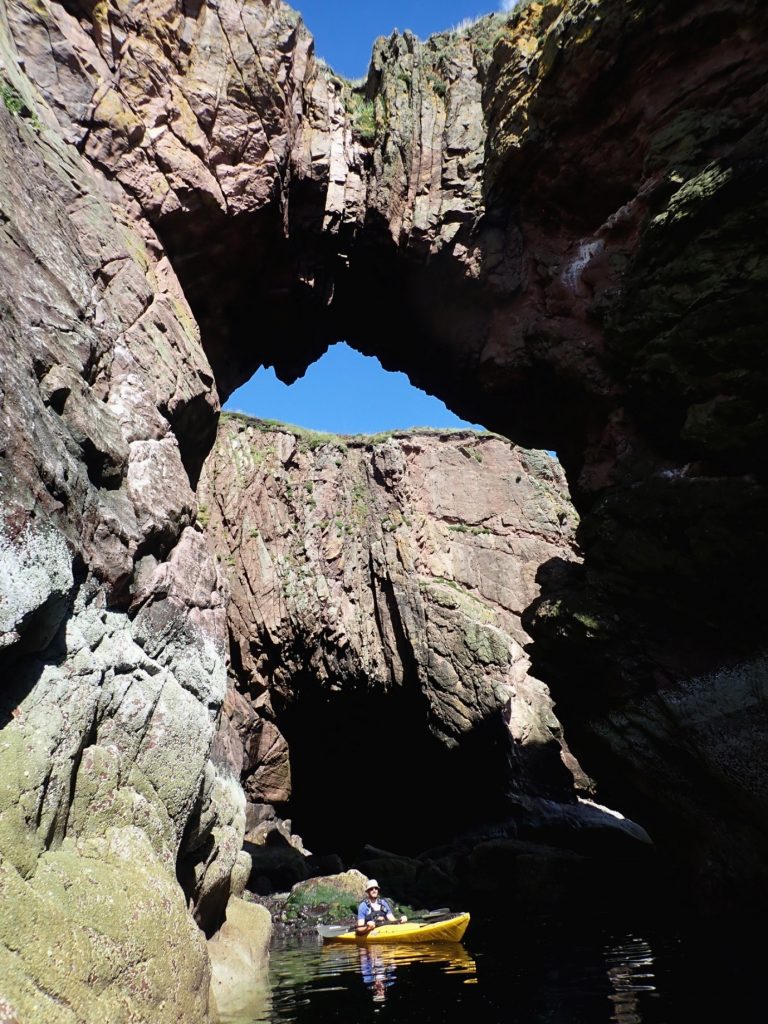
Local knowledge and advice often provides for the most memorable experiences and with Oldany Island coming highly recommended by Will Copestake of Kayak Summer Isles, it was the natural way to spend our last day in the area. Paddling out from the pristine beach at Clashnessie to the exposed outside of Oldany Island, with views back towards the Point of Stoer, we were soon rising and falling on the powerful swell with the crashing of the sea against the rocks adding a sense of exposure. As we rounded the island we again found ourselves engulfed in mist, adding to the atmosphere and creating a sense of isolation. With the disorientating mist and distraction of dozens of curious seals, we were soon lost in the maze of small islands, finding ourselves paddling into several dead ends before regaining the narrow channel separating Oldany Island from the mainland. The final few km along the coastline to Clashnessie provided plenty of interest and a magnificent archway to paddle under.

After a week of good fortune our weather window was closing and it was time for us to return home, our need for adventure sated for now, but with plans already forming for a return to explore more of this beautiful and dramatic coastline.

Day One: Loch Ewe
Day Two: Southern Summer Isles
Day Three: Northern Summer Isles
Days Four & Five: Achnahaird to Bay of Stoer and return
Day Six: Clashnessie & Oldany Island

Powered by WordPress & Theme by Anders Norén